
Best Shop Vacs for Workshops: Cleanup and Dust Control
Compare wet/dry vacuums and tool-connected extractors for sawdust, wood chips, renovation debris and everyday workshop cleanup.
Compare Shop Vac OptionsCompare Six ModelsAffiliate disclosure: As an Amazon Associate, WorkshopGearGuide may earn from qualifying purchases made through qualifying links, at no additional cost to you. Retailer specification links below are provided for verification and are not represented as Amazon offers.
Quick answer
For most general garage cleanup, a large wet/dry model such as the RIDGID HD1600 or CRAFTSMAN CMXEVBE17595 offers useful capacity. For a compact bench area, the Vacmaster Beast is easier to store. If sanding dust and automatic filter cleaning matter more than drum size, consider a dedicated extractor such as the Bosch VAC090AH. A conventional shop vac is not automatically a compliant silica-control system.
Compare workshop shop vacs by capacity, hose and filtration
Capacity, hose diameter, bags and filter maintenance determine how well a vacuum fits a specific workshop task. Peak horsepower alone is a poor comparison metric.
| Vacuum / capacity | Best workshop task | Collection setup | Main limitation | Shop Options |
|---|---|---|---|---|
| RIDGID HD1600 | 16 gal | Heavy debris cleanup | 2-1/2 in locking hose | Detachable blower | Check Prices |
| Vacmaster Beast VFB511B 0201 | 5 gal | Compact workshop cleanup | High-efficiency filter and bag | 320 air watts claimed | Check Prices |
| CRAFTSMAN CMXEVBE17595 | 16 gal | Renovation debris | 2-1/2 in Dual-Flex hose | Large tank with drain | Check Prices |
| DEWALT DXV09P | 9 gal | Mid-size general use | Wet/dry utility vacuum | Poly drum with drain | Check Prices |
| Bosch VAC090AH | 9 gal | Fine-dust tool extraction | HEPA filter and auto cleaning | Automatic filter cleaning | Check Prices |
| FEIN Turbo I | 5.8 gal | Portable tool-connected work | 13 ft hose and 19 ft cord | Automatic tool-start outlet | Check Prices |
Amazon links are product-category searches. Specific models sold by exclusive retailers may not be available on Amazon; verify model numbers before purchasing.
Six shop vacs reviewed for workshop use
The models serve different roles: high-volume debris pickup, compact bench cleanup, and tool-connected fine-dust extraction. The comparisons are based on published specifications, not hands-on testing.
RIDGID HD1600
Model: HD1600
Published configuration: RIDGID HD1600 with 16 gal nominal tank capacity.
Large tank and blower versatility Best for broad cleanup of chips, debris and wet messes in a larger garage.
Why consider it: Large tank and blower versatility
Trade-off: A large footprint and standard filter should not be mistaken for certified fine-dust protection.
Best suited to: Best for broad cleanup of chips, debris and wet messes in a larger garage.
Vacmaster Beast VFB511B 0201
Model: 0201
Published configuration: Vacmaster Beast VFB511B 0201 with 5 gal nominal tank capacity.
Strong compact option with a bag for woodworking dust Best for bench cleanup and occasional power-tool collection in a small shop.
Why consider it: Strong compact option with a bag for woodworking dust
Trade-off: Small tank fills faster; published micron capture is not a full HEPA-system certification.
Best suited to: Best for bench cleanup and occasional power-tool collection in a small shop.
CRAFTSMAN CMXEVBE17595
Model: CMXEVBE17595
Published configuration: CRAFTSMAN CMXEVBE17595 with 16 gal nominal tank capacity.
Large-capacity wet/dry cleaning with onboard accessories Best for high-volume cleanup and bulky offcuts in a garage.
Why consider it: Large-capacity wet/dry cleaning with onboard accessories
Trade-off: The wide hose is useful for chips, but power-tool ports may require a reducer.
Best suited to: Best for high-volume cleanup and bulky offcuts in a garage.
DEWALT DXV09P
Model: DXV09P
Published configuration: DEWALT DXV09P with 9 gal nominal tank capacity.
A manageable size between compact and 16-gallon machines Best for users who want a general-purpose workshop vacuum without an oversized drum.
Why consider it: A manageable size between compact and 16-gallon machines
Trade-off: Verify the exact included hose and filter configuration before ordering.
Best suited to: Best for users who want a general-purpose workshop vacuum without an oversized drum.
Bosch VAC090AH
Model: VAC090AH
Published configuration: Bosch VAC090AH with 9 gal nominal tank capacity.
A dedicated dust extractor for tool-connected fine-dust jobs Best for users prioritizing filter maintenance and tool-connected dust extraction.
Why consider it: A dedicated dust extractor for tool-connected fine-dust jobs
Trade-off: More expensive than conventional wet/dry shop vacs; task compliance depends on the full setup.
Best suited to: Best for users prioritizing filter maintenance and tool-connected dust extraction.
Product specifications: Bosch VAC090AH
FEIN Turbo I
Model: I
Published configuration: FEIN Turbo I with 5.8 gal nominal tank capacity.
Long reach and tool-triggered startup in a compact extractor Best for portable sanding and cleanup when automatic tool activation is useful.
Why consider it: Long reach and tool-triggered startup in a compact extractor
Trade-off: Class L and filtration claims should not be treated as equivalent to a certified US HEPA system.
Best suited to: Best for portable sanding and cleanup when automatic tool activation is useful.
Six checks before buying a workshop shop vac
Five-gallon tanks are easier to move; 16-gallon tanks reduce emptying during large cleanups.
Wide hoses resist clogging from chips, while smaller hoses may fit tool ports more easily.
Fine dust calls for a suitable filter and often a disposable bag; confirm the full system rating.
Peak horsepower is not airflow at the tool. Hose restrictions and loaded filters change performance.
Use the manufacturer-approved filter or float configuration for liquids; never mix incompatible dust and water.
Price replacement filters, bags, adapters and hoses before choosing a vacuum.
How to choose a shop vac for your workshop
Start with the debris and tools
Wood chips and spilled liquids call for different filter and hose configurations than continuous sanding dust.
Match capacity to storage space
Large drums reduce emptying but take more floor space. A compact vac may be better under a bench.
Understand fine-dust filtration
A high-efficiency filter is not necessarily HEPA, and a HEPA cartridge alone does not prove a sealed or compliant system.
Compare the complete working setup
Include hose length, adapters, filter bags, automatic tool-start and replacement-part costs.
Compare current workshop shop vac options
Check exact model numbers, replacement filters, hose sizes and included accessories before buying.
Compare Shop VacsCompare Fine-Dust OptionsHow we evaluated workshop shop vacs
We compared manufacturer-stated capacity, hose arrangements, filtration features, maintenance needs and tool-connection options. No laboratory airflow or fine-dust leakage tests were performed.
What published specifications can and cannot show
Tank volume and included accessories are useful for narrowing options, but advertised peak horsepower is not measured pickup performance.
Dust control also depends on hose losses, seals, bags, filter condition and the actual task.
What matters most
- Tank capacity and ease of emptying.
- Hose diameter, reach and tool-port fit.
- Filter, bag and automatic-cleaning options.
- Wet/dry operating requirements and service parts.
- Expansion: compatible top chests and side cabinets where documented.
Three specifications that matter for shop vacs
Use these checks to avoid comparing models by peak horsepower alone.
Published claims vary by model and test conditions; verify the complete configuration with the manufacturer.
Which shop vac fits your workshop?
Choose by cleanup task and filter requirements rather than assuming one vacuum fits every workshop.
Large drum and blower option for chips and wet/dry cleanup.
Read this reviewCompact 5-gallon setup for routine bench and floor cleanup.
Read this reviewAutomatic filter cleaning and a dedicated extractor configuration.
Read this reviewCompare 56-inch cabinets with stacked chest combinations based on tool shape and vertical reach. More overall volume is not always easier to use.
Review the large-capacity cabinetFive workshop shop vac mistakes to avoid
Peak HP does not describe actual airflow through a hose and loaded filter.
A compatible bag can reduce filter clogging during fine-dust cleanup.
Follow the exact wet-pickup filter instructions for your model.
Confirm tool-port diameters and reducers before buying.
A general wet/dry vac is not automatically an approved silica-control setup.
Shop vac questions answered
What size shop vac is best for a woodworking shop?
A compact 5-gallon model is often enough for bench cleanup; a 12- to 16-gallon drum is more convenient for high-volume chips and floor debris.
Is a shop vac the same as a dust extractor?
No. Some extractors add automatic filter cleaning, tool-start outlets and specialized filtration. Check the exact model and full-system claims.
Can I connect a shop vac to a table saw?
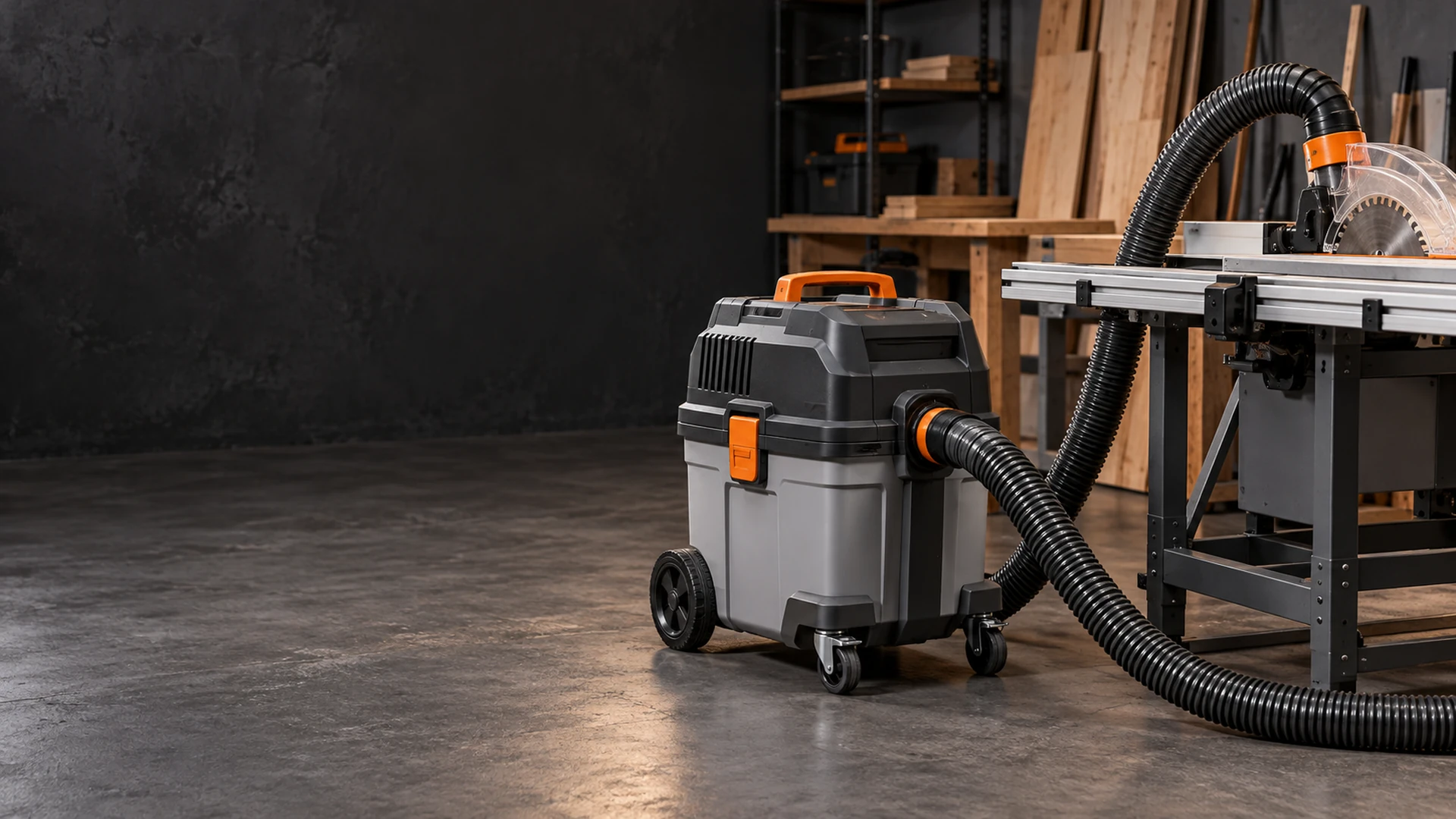
Sometimes, especially at small ports, but a high-volume stationary dust collector is often better for large chip-producing machines.
Do I need a dust bag with a shop vac?
For fine dry dust, a compatible collection bag often helps maintain suction and makes disposal cleaner. Follow the manufacturer instructions.
Is a HEPA filter enough for concrete dust?
Not by itself. Dust-control compliance depends on the complete vacuum, shroud, filtration, airflow and task-specific requirements.
Can shop vacs collect water and sawdust?
Many wet/dry vacuums can handle both in separate approved operating configurations. Change filters and bags as instructed.
How often should I replace shop vac filters?
Inspect performance and the filter condition frequently. Clean or replace according to the model manual and dust type, not a universal interval.
Related workshop guides
Research notes & specification sources
Research approach. This comparison uses published manufacturer specifications and feature descriptions, not hands-on pickup or filtration testing.
Representative primary sources used for the comparisons and calculations:
- RIDGID HD1600 — published specifications
- Vacmaster Beast VFB511B 0201 — published specifications
- CRAFTSMAN CMXEVBE17595 — published specifications
- DEWALT DXV09P — published specifications
- Bosch VAC090AH — published specifications
- FEIN Turbo I — published specifications
External source links are informational. Affiliate buttons on this page link to Amazon searches and may show alternative products rather than the exact retailer-exclusive model discussed.