
Best Combination Belt and Disc Sanders
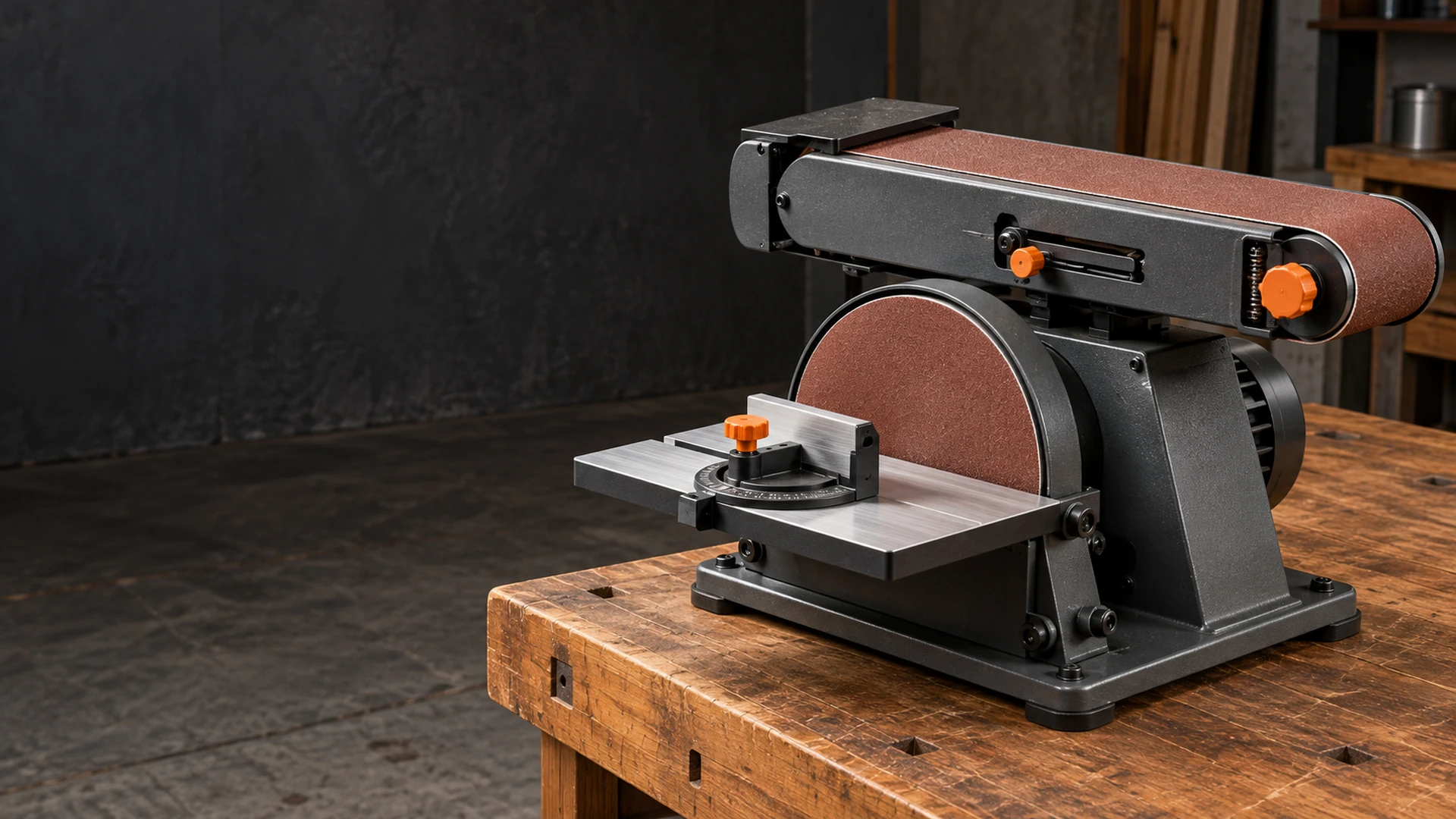
Choose a belt-and-disc sander by abrasive size, table support, dust collection and the kind of edge or contour work you actually do.
Compare Current OptionsCompare SandersAffiliate disclosure: As an Amazon Associate, WorkshopGearGuide may earn from qualifying purchases made through qualifying links, at no additional cost to you. Retailer specification links below are provided for verification and are not represented as Amazon offers.
Quick answer
For compact woodworking, start with the WEN 6502T 4 x 36 belt and 6-inch disc. Choose BUCKTOOL BD4801 if an 8-inch disc is important, RIKON 50-120 for broad stock and a 6-inch belt, or JET J-4002 for narrow detail shaping. These recommendations compare published specifications, not hands-on tests.
Compare combination belt and disc sanders
Belt width, disc diameter and motor ratings answer different questions. Check table support, abrasive availability and dust-port fit before buying; motor amps and horsepower are not directly interchangeable.
| Sander / best fit | Belt size | Disc diameter | Published motor | Shop Options |
|---|---|---|---|---|
| WEN 6502T Entry-level edge shaping | 4 x 36 in | 6 in | 4.3 A | Check Prices |
| BUCKTOOL BD4801 General-purpose shaping | 4 x 36 in | 8 in | 3/4 HP | Check Prices |
| RIKON 50-120 Wide stock and longer edges | 6 x 48 in | 10 in | 3/4 HP | Check Prices |
| JET J-4002 Curves and narrow profiles | 1 x 42 in | 8 in | 1/3 HP | Check Prices |
Amazon links are product-category searches. Specific models sold by exclusive retailers may not be available on Amazon; verify model numbers before purchasing.
Detailed product evaluations
Each model below is evaluated from published specifications and practical workshop fit. We have not physically tested these machines. Confirm current manuals, dust-port adapters and replacement abrasives for the exact model before ordering.
WEN 6502T
Model: 6502T
Published configuration: 4 x 36 in abrasive belt, 6 in sanding disc, 4.3 A motor.
The cast-iron-base layout pairs a wide horizontal or upright belt with a compact disc. It suits small hardwood pieces and hobby projects where bench space matters. Keep fingers away from the moving abrasive and support short workpieces with suitable jigs.
Why consider it: Accessible 4 x 36 belt format and a relatively compact footprint.
Trade-off: The 6-inch disc offers less usable sanding radius than an 8- or 10-inch disc.
Best suited to: Entry-level edge shaping.
BUCKTOOL BD4801
Model: BD4801
Published configuration: 4 x 36 in abrasive belt, 8 in sanding disc, 3/4 HP motor.
A direct-drive arrangement and larger disc make this a useful step up when both belt shaping and disc squaring matter. Its tilting belt changes the orientation for different workholding tasks. Keep fingers away from the moving abrasive and support short workpieces with suitable jigs.
Why consider it: 8-inch disc and 0-to-90-degree belt positioning expand the usable work envelope.
Trade-off: Two dust ports and machine placement need planning before installation.
Best suited to: General-purpose shaping.
RIKON 50-120
Model: 50-120
Published configuration: 6 x 48 in abrasive belt, 10 in sanding disc, 3/4 HP motor.
The 6-inch belt gives more contact width for broader workpieces, while the 10-inch disc adds capacity for squaring larger edges. Its mass and footprint are substantial for a small bench. Keep fingers away from the moving abrasive and support short workpieces with suitable jigs.
Why consider it: Wide abrasive belt, cast-iron construction and a larger disc.
Trade-off: At about 92 lb, this is not a machine to move frequently.
Best suited to: Wide stock and longer edges.
JET J-4002
Model: J-4002
Published configuration: 1 x 42 in abrasive belt, 8 in sanding disc, 1/3 HP motor.
The narrow belt is suited to localized shaping, contours and small components rather than flattening wide boards. The 8-inch disc supports repeatable end-grain and angle work. Keep fingers away from the moving abrasive and support short workpieces with suitable jigs.
Why consider it: Narrow belt reaches areas a 4-inch platen cannot easily access.
Trade-off: Not a replacement for a wide-belt machine when flattening larger faces.
Best suited to: Curves and narrow profiles.
Six checks before buying a belt and disc sander
Use a narrow belt for small profiles and a wide belt for straight edges and broader stock.
A larger disc supports longer edges but needs enough space and a stable table.
Inspect table tilt, miter-gauge support and workpiece clearance.
Check both sanding stations for port location and suitable extractor adapters.
Buy standard belt and disc sizes that are readily available in useful grits.
Leave room to tilt the belt, feed long stock and safely access the power switch.
How to choose the right belt and disc combination
Narrow belt versus wide belt
A narrow 1-inch belt is useful for contours and small profiles. A 4- or 6-inch belt makes more sense for long straight edges and larger stock.
Six-inch versus eight- or ten-inch disc
The disc works best for squaring short edges against a supported table. A larger disc increases the working radius but needs additional clearance.
Bench space versus machine mass
Heavier cast-iron machines resist movement, yet can be awkward to relocate. Choose a stable mounting position before selecting a larger unit.
Dust capture and abrasive changes
Confirm port diameters, vacuum compatibility, replacement belt tensioning and whether the disc uses adhesive or hook-and-loop backing.
Compare current combination sanding machines
Browse current belt and disc configurations, then confirm the exact model, abrasive sizes and manual before buying.
Compare belt-disc sandersCompare replacement abrasivesHow we compared these sanding machines
We compared documented abrasive dimensions, motor ratings, table orientation and dust provisions. No physical tests or measured sanding performance are claimed.
What we verified
The useful distinction is the work envelope: a wide belt for stock shaping, a narrow belt for profiles, and a larger disc for squaring edges. Always consult the operator manual for safe workholding.
Product specifications and configurations can change. Check current manufacturer instructions and replacement-abrasive availability before purchasing.
Which trade-offs matter
- Abrasive fit: match belt width and disc diameter to actual workpieces.
- Work support: compare tables, miter gauges and belt orientation.
- Motor data: distinguish rated horsepower from amperage without treating them as equivalent.
- Dust capture: confirm collection ports and extractor compatibility.
- Maintenance: check belt tracking, tensioning and abrasive availability.
Three dimensions that shape the buying decision
These are published abrasive dimensions, not performance test results. They illustrate why two combination sanders can serve very different work.
Abrasive size alone does not establish stock-removal rate, surface quality or motor endurance. Compare table stability, belt tracking and dust control as well.
Which combination sander fits your workshop?
Choose by task rather than assuming a larger motor or disc always produces a better finish.
The WEN 6502T is a practical starting point for common woodworking edges, with a familiar 4 x 36 belt format.
Review WEN 6502TThe BUCKTOOL BD4801 provides an 8-inch disc and a 4-inch-wide belt in one unit.
Review BUCKTOOL BD4801The RIKON 50-120 offers a 6-inch-wide belt and a 10-inch disc, with substantial machine weight.
Review RIKON 50-120The JET J-4002 uses a 1-inch belt to reach narrow profiles and localized areas.
Review JET J-4002Five combination-sander mistakes to avoid
Motor ratings use different units and do not substitute for belt support, tracking and appropriate workholding.
Confirm belt dimensions and disc attachment style before choosing a model with unusual consumables.
Fine sanding dust can escape even with a connected extractor. Follow dust-control and respiratory-protection guidance.
Work on the downward-moving side of the disc to reduce the risk of lifting a workpiece off the table.
Use appropriate jigs and the machine manual; never hold tiny pieces close to moving abrasives with fingertips.
Combination belt and disc sander FAQs
What is a combination belt and disc sander best used for?
It combines belt-based edge shaping and contour work with disc-based squaring and angle sanding. It is not a replacement for a thickness planer or a random-orbit finishing sander.
Is a 4 x 36 belt large enough for a home workshop?
For small and medium parts, a 4 x 36 belt is a useful general-purpose size. Larger workpieces benefit from the support of a wider and longer belt.
When is a 1-inch belt better than a 4-inch belt?
A narrow belt reaches tighter contours and profiles. A wide belt provides more abrasive contact for straight edges and broader stock.
Does a larger sanding disc make a difference?
A larger disc offers a greater working radius for longer edges, but also requires more clearance and secure table support.
Can a belt-disc sander replace a spindle sander?
Not completely. A spindle sander is better suited to many internal curves; a belt-disc combination is more versatile for straight edges and external contours.
How should I connect dust collection?
Match the dust-port diameter to your vacuum or collector with the proper adapter, and follow the machine manual. Dust capture is not perfect, so control exposure appropriately.
Can I sand metal on a woodworking belt-disc sander?
Only when the manufacturer explicitly permits the material and abrasive. Sparks and combustible wood dust are a dangerous combination; never assume a woodworking dust system is suitable for metal grinding.
Related workshop guides
Research notes & specification sources
Research approach. This guide is an editorial comparison of publicly available specifications. It is not based on personal ownership, instrumented tests, or manufacturer sponsorship. Specifications can change; check the exact model number and current seller documentation before purchasing.
Representative primary sources used for the comparisons and calculations:
- WEN 6502T product specifications (belt and disc sizes, motor and configuration).
- BUCKTOOL BD4801 product specifications (belt and disc sizes, motor and configuration).
- RIKON 50-120 product specifications (belt and disc sizes, motor and configuration).
- JET J-4002 product specifications (belt and disc sizes, motor and configuration).
External source links are informational. Affiliate buttons on this page link to Amazon searches and may show alternative products rather than the exact retailer-exclusive model discussed.