
Best Benchtop Belt Sanders for Workshop Tasks
Compare compact benchtop belt sanders by belt format, workpiece support, dust handling and real workshop fit. Verify exact specifications before ordering.
Browse benchtop belt sandersCompare Six OptionsAffiliate disclosure: As an Amazon Associate, WorkshopGearGuide may earn from qualifying purchases made through qualifying links, at no additional cost to you. Retailer specification links below are provided for verification and are not represented as Amazon offers.
Quick answer
For small shaping and edge-smoothing tasks, a compact 1 x 30-inch belt-and-disc unit is a practical starting point. A 2 x 42-inch belt offers more working length, while a dedicated 1 x 42-inch belt machine favors narrow work. Check guards, work rests, abrasives and dust collection before choosing.
Compare benchtop belt sanders
Compare belt format and machine layout first; power, speed and work-rest details must be verified against the exact model revision. These are not interchangeable tools.
| sander / best fit | Width × depth | belts | Published strength detail | Shop Options |
|---|---|---|---|---|
| WEN 6515T | 1 x 30 in belt | 5 in disc | Belt and disc combination | Small projects and shaping |
| RIKON 50-151 | 1 x 30 in belt | 5 in disc | Belt and disc combination | Light-duty woodworking |
| JET J-41002 | 2 x 42 in belt | 8 in disc | Belt and disc combination | Metal and wood shop tasks |
| Kalamazoo 1SM | 1 x 42 in belt | Belt-only configuration | Bench-mounted belt sander | Deburring and narrow work |
Compare belt format and machine layout first; power, speed and work-rest details must be verified against the exact model revision. These are not interchangeable tools.
Detailed benchtop sander evaluations
Editorial comparisons based on product configurations and typical workshop use; no hands-on testing is claimed.
WEN 6515T
Model family: WEN 6515T
Published configuration: Belt and disc combination; 1 x 30 in belt; 5 in disc. Confirm accessories.
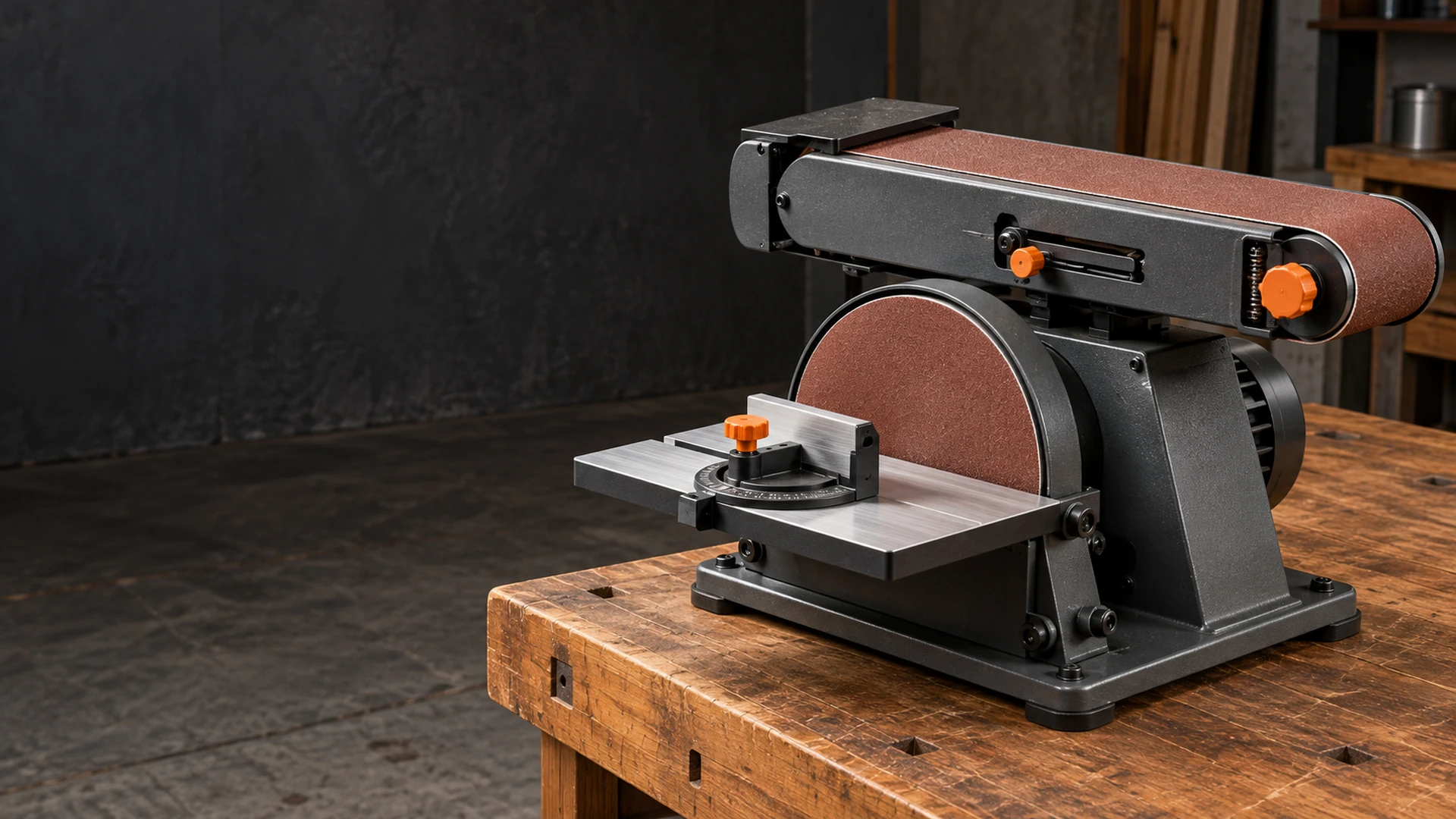
WEN 6515T is worth comparing for small projects and shaping. Check the supported belt length and width, table stability, tracking adjustment, replacement abrasive availability and guarding. The machine footprint matters as much as the nominal abrasive size.
Why consider it: A 1 x 30 in belt format for small projects and shaping.
Trade-off: Confirm work-rest adjustments, dust pickup and duty rating.
Best suited to: Small projects and shaping.
RIKON 50-151
Model family: RIKON 50-151
Published configuration: Belt and disc combination; 1 x 30 in belt; 5 in disc. Confirm accessories.
RIKON 50-151 is worth comparing for light-duty woodworking. Check the supported belt length and width, table stability, tracking adjustment, replacement abrasive availability and guarding. The machine footprint matters as much as the nominal abrasive size.
Why consider it: A 1 x 30 in belt format for light-duty woodworking.
Trade-off: Confirm work-rest adjustments, dust pickup and duty rating.
Best suited to: Light-duty woodworking.
JET J-41002
Model family: JET J-41002
Published configuration: Belt and disc combination; 2 x 42 in belt; 8 in disc. Confirm accessories.
JET J-41002 is worth comparing for metal and wood shop tasks. Check the supported belt length and width, table stability, tracking adjustment, replacement abrasive availability and guarding. The machine footprint matters as much as the nominal abrasive size.
Why consider it: A 2 x 42 in belt format for metal and wood shop tasks.
Trade-off: Confirm work-rest adjustments, dust pickup and duty rating.
Best suited to: Metal and wood shop tasks.
Kalamazoo 1SM
Model family: Kalamazoo 1SM
Published configuration: Bench-mounted belt sander; 1 x 42 in belt; Belt-only configuration. Confirm accessories.
Kalamazoo 1SM is worth comparing for deburring and narrow work. Check the supported belt length and width, table stability, tracking adjustment, replacement abrasive availability and guarding. The machine footprint matters as much as the nominal abrasive size.
Why consider it: A 1 x 42 in belt format for deburring and narrow work.
Trade-off: Confirm work-rest adjustments, dust pickup and duty rating.
Best suited to: Deburring and narrow work.
Six buying checks that matter more than marketing labels
Check exact belt width and length. Common sizes such as 1 x 30 and 2 x 42 inches require different replacement belts.
A stable work rest helps support short workpieces. Confirm adjustment range and clearance against the abrasive.
Inspect manufacturer instructions for tracking and guarding before operation. Never defeat a guard.
Check whether the machine has a dust port and whether its use is appropriate for your material.
Confirm voltage, motor duty rating and intended material with the manufacturer.
Leave clearance for feeding and removing stock, and secure the machine according to the manual.
How to choose the right configuration
Belt dimensions and abrasive availability
Check exact belt width and length. Common sizes such as 1 x 30 and 2 x 42 inches require different replacement belts.
Work-rest support and alignment
A stable work rest helps support short workpieces. Confirm adjustment range and clearance against the abrasive.
Tracking adjustment and guards
Inspect manufacturer instructions for tracking and guarding before operation. Never defeat a guard.
Dust collection compatibility
Check whether the machine has a dust port and whether its use is appropriate for your material.
Benchtop belt sander buying considerations
Browse current configurations and pricing, then cross-check exact model numbers and dimensions against the source specifications above.
Compare benchtop sandersCompare abrasive beltsHow we compared these benchtop sanders
We compared published configuration information, abrasive formats, maintenance requirements and typical use cases. No physical testing was performed. Check manufacturer manuals for current revisions and safety requirements.
What we checked, and what we did not
We compared published configuration information, abrasive formats, maintenance requirements and typical use cases. No physical testing was performed. Check manufacturer manuals for current revisions and safety requirements.
We compared published configuration information, abrasive formats, maintenance requirements and typical use cases. No physical testing was performed. Check manufacturer manuals for current revisions and safety requirements.
What matters most
- Fit: footprint, depth, and belt-opening clearance.
- Tool access: useful belt widths and depths, not just belt count.
- Loading: sander ratings and individual slide ratings treated separately.
- Mobility: foot layout, latches, floor condition, and thresholds.
- Expansion: compatible top chests and side sanders where documented.
Three numbers that change the buying decision
Belt width and length influence contact area and replacement abrasive selection. A 1 x 30-inch belt differs materially from a 2 x 42-inch belt. Dust extraction compatibility and table clearance must be checked for each machine.
Belt width and length influence contact area and replacement abrasive selection. A 1 x 30-inch belt differs materially from a 2 x 42-inch belt. Dust extraction compatibility and table clearance must be checked for each machine.
Which benchtop belt sander actually fits your workshop?
Choose a compact 1 x 30-inch machine for small edges and craft work; consider a 2 x 42-inch layout for longer sanding contact; choose a dedicated belt unit when a disc station is unnecessary.
Compare published belt width and length rather than treating all bench sanders as interchangeable.
Review the compact WEN configurationVerify table and work-rest geometry for the shape and size of your workpieces.
Compare mobile work surface optionsMatch dust-control equipment to the machine manual and the material being sanded.
Compare the benchtop sander optionsSelect the correct abrasive size, backing and grit for the intended task.
Review the large-capacity sanderFive costly buying mistakes to avoid
Compare published belt width and length rather than treating all bench sanders as interchangeable.
Verify table and work-rest geometry for the shape and size of your workpieces.
Match dust-control equipment to the machine manual and the material being sanded.
Select the correct abrasive size, backing and grit for the intended task.
Follow the manufacturer procedure for belt tracking, guards and machine mounting.
benchtop belt sander FAQs
What is a benchtop belt sander best used for?
Small edges, shaping, deburring and controlled material removal on supported workpieces.
Is a 1 x 30-inch belt large enough for woodworking?
It suits small projects, but larger pieces may benefit from a longer or wider abrasive surface.
Should I choose a belt-only or belt-and-disc machine?
A disc station adds a flat abrasive face; a belt-only machine can be simpler when the belt does all your work.
Can a benchtop belt sander sharpen metal tools?
Only if the machine and abrasive are rated for the material and the manufacturer permits that use.
How do I reduce dust when belt sanding?
Use compatible extraction where specified, appropriate respiratory protection and good shop housekeeping.
Why does belt tracking matter?
Poor tracking can rub guards, damage belt edges and reduce control. Follow the adjustment instructions.
What should I check before buying replacement belts?
Match both width and length, backing type, grit and material compatibility to the exact machine.
Related workshop guides
Research notes & specification sources
Research approach: configuration-based editorial analysis, not hands-on testing. Verify exact dimensions, speed, electrical requirements, warranty and accessories from manufacturer documentation before purchase.
Research approach: configuration-based editorial analysis, not hands-on testing. Verify exact dimensions, speed, electrical requirements, warranty and accessories from manufacturer documentation before purchase.
- WEN manufacturer (dimensions, belt-slide details).
- RIKON manufacturer (dimensions, rated volume, load, and slides).
- JET manufacturer (editorial standards, not product specifications).
Research approach: configuration-based editorial analysis, not hands-on testing. Verify exact dimensions, speed, electrical requirements, warranty and accessories from manufacturer documentation before purchase.