
Best Dust Collection Fittings for Workshop Connections
Compare Y-fittings, reducers, quick-change adapters and mountable couplers by port geometry, connection style and workshop layout.
Compare Dust FittingsCompare Fitting TypesAffiliate disclosure: As an Amazon Associate, WorkshopGearGuide may earn from qualifying purchases made through qualifying links, at no additional cost to you. Retailer specification links below are provided for verification and are not represented as Amazon offers.
Quick answer
Match the actual outside diameter of each tool port to the inside diameter of its hose cuff or adapter. Use Y-fittings for branches, reducers only where required, and quick-change ports when one hose serves several machines. A nominal four-inch label alone does not guarantee a leak-free connection.
Compare dust collection fittings by connection task
These six fittings solve different problems: branching, reducing, swapping hoses and creating accessible tool connections. Choose by the geometry of the existing system, not by the product name alone.
| Dust collection fitting | Best use | Nominal connection | Fitting style | Shop Options |
|---|---|---|---|---|
| POWERTEC 70106 4-Inch Y-Fitting | Two 4-inch machine branches | 4 x 4 x 4 in | Three-way Y junction | Check Prices |
| POWERTEC 70190 Mixed-Size Y-Fitting | Mixed 4-inch and 2-1/2-inch ports | 4 x 4 x 2-1/2 in | Mixed-diameter Y branch | Check Prices |
| POWERTEC 70276 Dust Collection Splitter | Two smaller hoses from a 4-inch inlet | 4 to dual 2-1/2 in | Two smaller outlet branches | Check Prices |
| Rockler Dust Right 4-Inch Quick Change Handle | One hose shared among machines | 4-inch hose system | Quick-change polymer handle | Check Prices |
| Rockler Dust Right 4-Inch Tool Ports 2-Pack | Dedicated tool-side connectors | 4-inch tool ports | Two flexible-ended ports | Check Prices |
| Rockler Dust Right Mountable Dust Coupler | Accessible bench or wall connection | 4-inch configuration | Mountable reinforced ABS coupler | Check Prices |
Shopping links open model-name searches. Verify actual mating dimensions and whether clamps, ports or reducers are included before ordering.
Dust collection fittings compared
A fitting should solve a specific connection problem without introducing unnecessary restrictions. Below, each option is evaluated for its documented configuration, installation purpose and likely limitations.
POWERTEC 70106 4-Inch Y-Fitting
Model / configuration: POWERTEC 70106 4-Inch Y-Fitting
Published configuration: 4 x 4 x 4 in; Three-way Y junction.
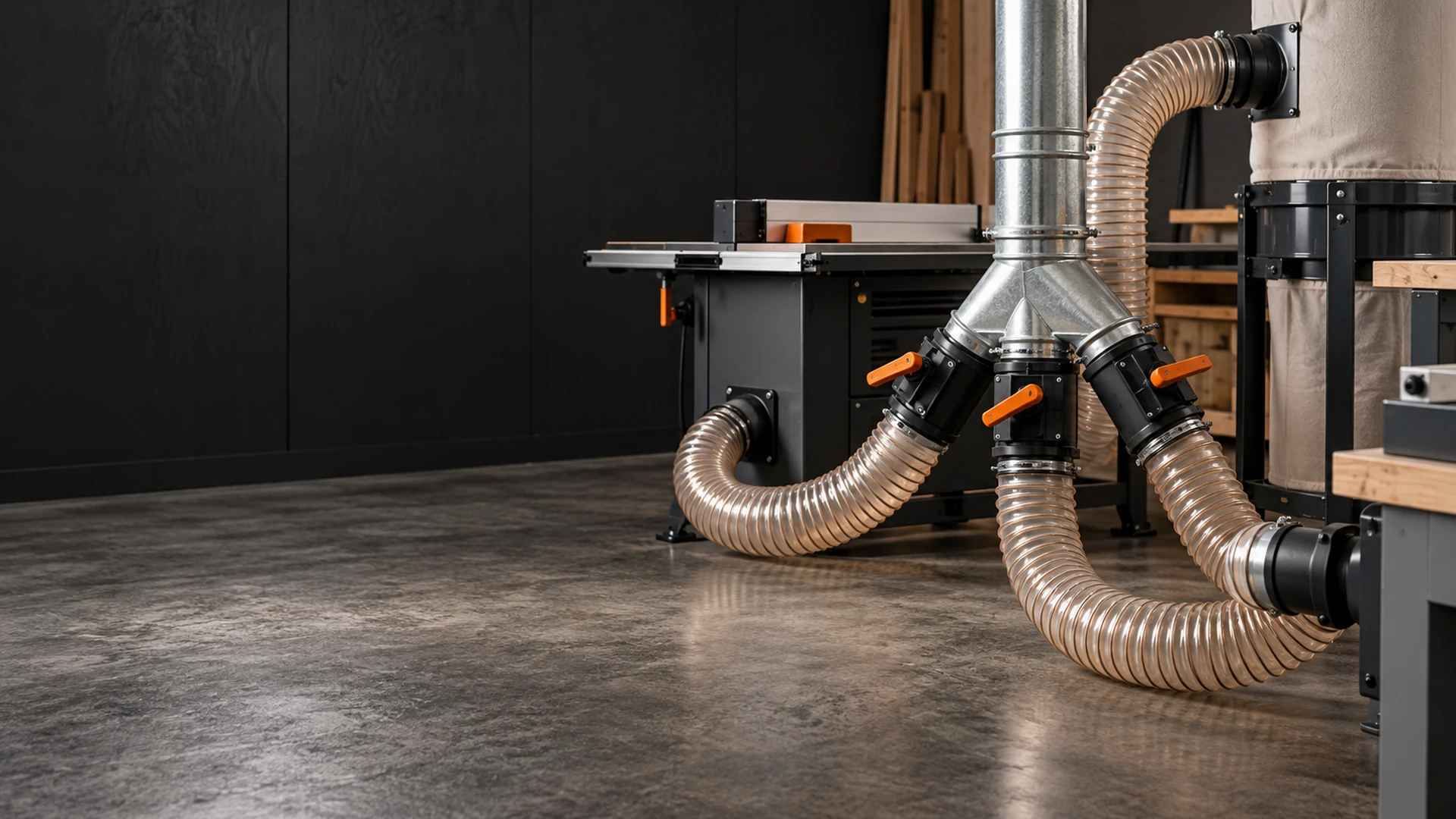
A Y-branch lets two collector runs meet without the abrupt crossflow of a tee. The 70106 is listed as a four-inch Y fitting in POWERTEC's catalog; confirm the hose cuff or rigid duct connection dimensions before installing.
Why consider it: Useful for splitting a four-inch dust collection run between two stationary tools while keeping branch routing relatively gradual.
Trade-off: A branch does not make two simultaneously open machines perform as well as a dedicated high-airflow system; add gates where appropriate.
Best suited to: Two 4-inch machine branches.
Published product information: POWERTEC 70106 4-Inch Y-Fitting
POWERTEC 70190 Mixed-Size Y-Fitting
Model / configuration: POWERTEC 70190 Mixed-Size Y-Fitting
Published configuration: 4 x 4 x 2-1/2 in; Mixed-diameter Y branch.
The 70190 joins a smaller nominal branch to a four-inch dust collection layout. It is most relevant when a benchtop tool has a smaller port but the primary collector run remains four inches.
Why consider it: Avoids improvising multiple stacked adapters when one machine needs a smaller branch from a wider trunk.
Trade-off: Reducing to a small tool port can limit airflow at that branch; verify the tool's dust collection requirements.
Best suited to: Mixed 4-inch and 2-1/2-inch ports.
Published product information: POWERTEC 70190 Mixed-Size Y-Fitting
POWERTEC 70276 Dust Collection Splitter
Model / configuration: POWERTEC 70276 Dust Collection Splitter
Published configuration: 4 to dual 2-1/2 in; Two smaller outlet branches.
POWERTEC lists the 70276 as a four-inch to two-and-a-half-inch splitter. It can organize a compact setup with two small dust pickup points, but the upstream collector must still supply adequate airflow.
Why consider it: Provides a defined split for small machine connections instead of assembling a chain of reducers.
Trade-off: Two narrow branches cannot substitute for a full-size collection port on a machine producing heavy chips.
Best suited to: Two smaller hoses from a 4-inch inlet.
Published product information: POWERTEC 70276 Dust Collection Splitter
Rockler Dust Right 4-Inch Quick Change Handle
Model / configuration: Rockler Dust Right 4-Inch Quick Change Handle
Published configuration: 4-inch hose system; Quick-change polymer handle.
Rockler item 55027 stays on a four-inch dust hose and mates with compatible Dust Right tool ports, sold separately. The angled handle and adjustable airflow valve are aimed at mobile or space-constrained shops.
Why consider it: Reduces the need to loosen hose clamps every time a single collector hose moves to another machine.
Trade-off: Requires compatible Dust Right tool ports; the handle alone is not a complete connection kit.
Best suited to: One hose shared among machines.
Published product information: Rockler Dust Right 4-Inch Quick Change Handle
Rockler Dust Right 4-Inch Tool Ports 2-Pack
Model / configuration: Rockler Dust Right 4-Inch Tool Ports 2-Pack
Published configuration: 4-inch tool ports; Two flexible-ended ports.
Rockler item 25516 supplies two ports that attach to four-inch machine dust outlets and receive the Dust Right Quick Change Handle. Flexible rubber boots allow small variations in tool-port diameter.
Why consider it: A useful addition when the same collector hose needs to move among multiple four-inch woodworking machines.
Trade-off: The handle is separate, and tool-port geometry should be measured before purchase.
Best suited to: Dedicated tool-side connectors.
Published product information: Rockler Dust Right 4-Inch Tool Ports 2-Pack
Rockler Dust Right Mountable Dust Coupler
Model / configuration: Rockler Dust Right Mountable Dust Coupler
Published configuration: 4-inch configuration; Mountable reinforced ABS coupler.
The four-inch version of Rockler's mountable coupler provides a convenient hose connection on a wall, bench or cabinet. The stepped end works with four-inch hose and the Dust Right Quick Change Handle.
Why consider it: Moves an awkward hidden machine port to a convenient location and can also help join compatible hose sections.
Trade-off: Multiple coupler sizes are sold under this product family; choose the four-inch configuration deliberately.
Best suited to: Accessible bench or wall connection.
Published product information: Rockler Dust Right Mountable Dust Coupler
Six checks before buying dust collection fittings
Measure both mating surfaces: tool port OD and hose cuff ID, rather than relying on nominal labels.
Check whether a fitting is intended for flexible hose, rigid duct or a proprietary quick-change connector.
Use gradual Y-branches where practical; sharp tees and unnecessary elbows can add resistance.
Confirm whether a reducer narrows the effective airflow path below the tool manufacturer's recommended size.
Include blast gates, clamps and mounting hardware in the total installation plan when they are not supplied.
Choose quick-change components as a compatible system; a handle from one brand may not mate with another brand's ports.
How to plan a dust collection fitting layout
Map the machine ports
Write down each tool port outside diameter and the collector outlet size; identify which machines may run simultaneously.
Choose branches before reducers
Prefer maintaining the larger trunk diameter and use a reducer near a genuinely smaller tool connection.
Check the hose and duct ends
A nominal four-inch fitting may be designed to slip inside hose or over a pipe. Verify the manufacturer's inside and outside dimensions.
Test the assembled connection
Dry-fit the components, clamp or mount them securely, and check for leaks or blocked gates before collecting dust.
Choose fittings that actually match your dust ports
Start with the connection problem: branch a collector run, adapt a small tool port, or swap one hose among machines.
Compare Dust HosesSee Hose SizesHow we evaluated dust collection fittings
We compared documented port configurations, fitting purpose, included components and installation limitations. We did not measure static pressure, leakage or dust exposure.
What product specifications establish
Published nominal port sizes and component descriptions establish the intended connection family.
They do not establish that a particular hose cuff, tool port or rigid duct will fit without measurement.
What to verify before installation
- Tool-port outside diameter and hose-cuff inside diameter.
- Whether each fitting slips inside a hose or over a pipe.
- Which clamps, gates, mounting screws or tool ports are included.
- Compatibility between quick-change handles and their proprietary ports.
- The tool and collector manufacturer's airflow and grounding guidance.
Three connection sizes worth checking
Nominal diameters guide selection, but mating dimensions determine whether a fitting will actually seal.
Nominal dimensions are not a substitute for checking exact inside and outside mating diameters.
Which dust collection fitting fits your setup?
Pick the connector by the job it must do, not by a universal best-fitting claim.
A four-inch Y branch for two stationary machine runs.
Read this reviewA mixed-diameter Y branch for a smaller machine port.
Read this reviewA quick-change handle for moving one hose between tools.
Read this reviewA mountable coupler to bring a port within easy reach.
Read this reviewFive dust collection fitting mistakes to avoid
Measure tool-port OD, hose-cuff ID and fitting dimensions independently.
A long undersized run can starve a high-volume collector even if a reducer physically connects it.
A Y-branch is usually preferable to a sharp tee when routing airflow from machines.
A quick-change handle may require its own matching tool ports and clamps.
Confirm the full installation kit, including secure mounting and branch shutoff where needed.
Dust collection hose questions answered
How do I measure a dust collection fitting correctly?
Measure the outside diameter of the tool port and the inside diameter of the mating hose or fitting. Nominal sizes are not always actual mating dimensions.
What is the difference between a reducer and a coupler?
A reducer joins different diameters; a coupler joins compatible ends, often of the same nominal size. Check whether each end fits over or inside its mating part.
When should I use a Y fitting instead of a tee?
A swept Y fitting can provide a gentler airflow transition than a sharp tee. Actual pressure loss depends on branch angle, diameter and system layout.
Can dust collection adapters restrict airflow?
Yes. Sudden reductions, sharp turns and poorly fitting transitions add resistance. Use the shortest practical transition and avoid unnecessary diameter changes.
Are nominal 4-inch fittings interchangeable across brands?
Not always. Wall thickness, inside diameter, taper and connection style vary. Compare measured dimensions or manufacturer compatibility specifications.
How should I seal leaking duct fittings?
Use suitable clamps, gaskets or appropriate duct sealing tape at accessible joints. Keep fittings serviceable and follow the system manufacturer’s installation guidance.
Do I need separate fittings for rigid duct and flexible hose?
Often. Rigid pipe, flexible hose and machine ports can have different actual diameters even when all are described with the same nominal size.
Dust collection fitting questions answered
Research notes & specification sources
We reviewed POWERTEC fitting catalog listings and Rockler Dust Right product documentation for nominal dimensions, component configurations and intended connection use. No independent airflow or leakage testing was conducted.
Before purchasing, verify actual mating dimensions, included accessories and manufacturer recommendations for the connected tools and dust collector.
- POWERTEC 70106 4-Inch Y-Fitting published specifications
- POWERTEC 70190 Mixed-Size Y-Fitting published specifications
- POWERTEC 70276 Dust Collection Splitter published specifications
- Rockler Dust Right 4-Inch Quick Change Handle published specifications
- Rockler Dust Right 4-Inch Tool Ports 2-Pack published specifications
- Rockler Dust Right Mountable Dust Coupler published specifications
Editorial method: published product documentation and fit-based comparison; no hands-on testing claimed. Shopping buttons open affiliate-tagged searches.