
Best Woodworking Parallel Clamps for Glue-Ups
Compare opening capacity, throat depth, jaw pads and rail length for panels, cabinet assemblies and tabletop glue-ups.
Compare Current OptionsCompare Parallel ClampsAffiliate disclosure: As an Amazon Associate, WorkshopGearGuide may earn from qualifying purchases made through qualifying links, at no additional cost to you. Retailer specification links below are provided for verification and are not represented as Amazon offers.
Quick answer
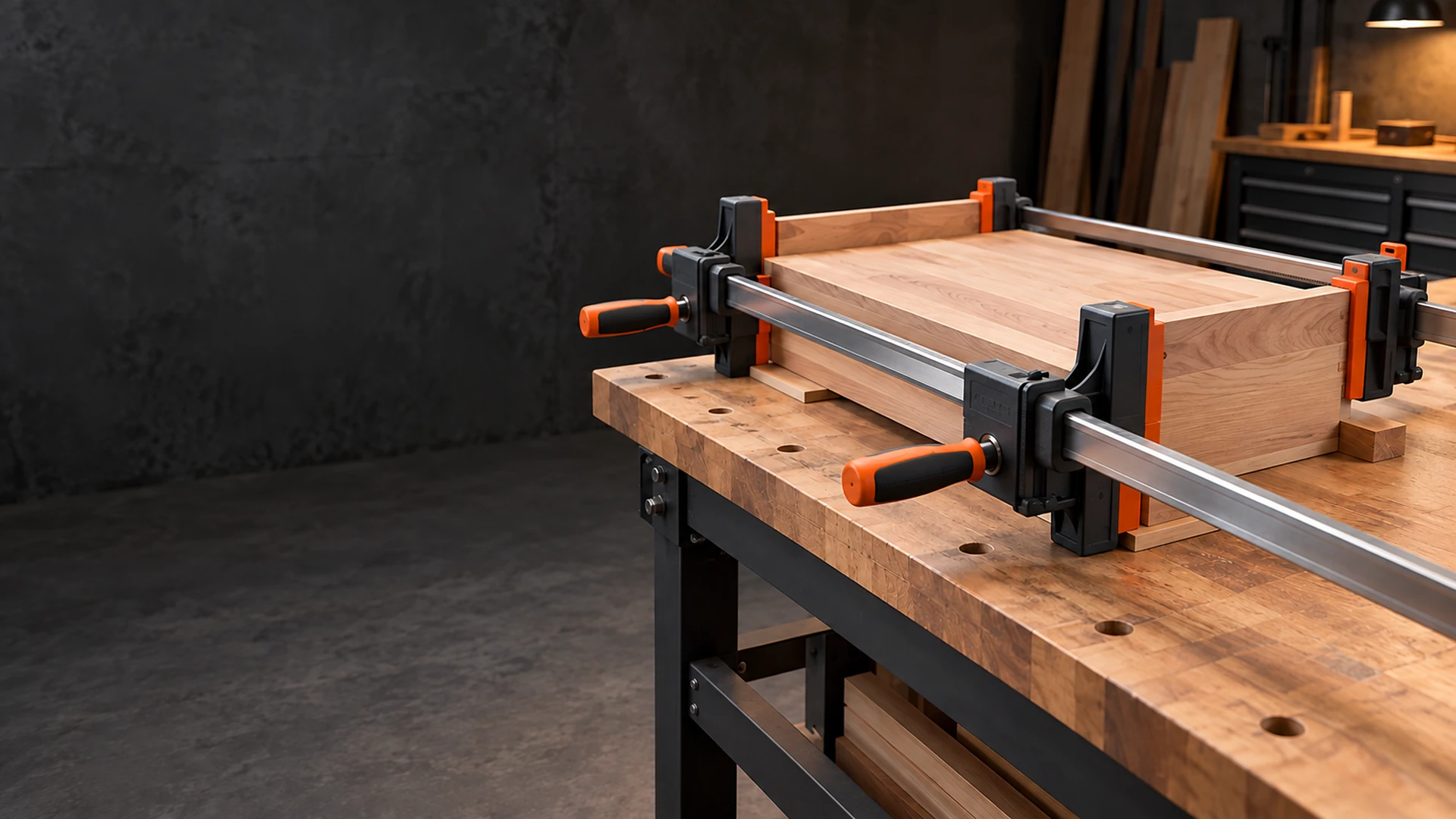
Match clamp length to the assembled width. Parallel-jaw clamps distribute pressure across broad pads, but the workpiece must already be milled square. Choose enough opening for cauls and protective pads; alternate clamp placement above and below wide panels to reduce bowing.
Compare parallel clamps by usable reach
Opening capacity and throat depth are different measurements. Use published model dimensions and dry-fit each assembly before applying glue.
| Clamp / best use | Opening / throat | Force / weight | Distinct advantage | See prices |
|---|---|---|---|---|
| BESSEY KRE3524 Panels and cabinet boxes | 24 in capacity / 3-3/4 in throat | 1700 lb nominal / 6.1 lb | Large replaceable jaw pads distribute pressure and support square assemblies. | See Prices |
| BESSEY KRE3531 Medium cabinet glue-ups | 31 in capacity / 3-3/4 in throat | 1700 lb nominal / 6.9 lb | Adds seven inches of nominal opening over KRE3524 with the same broad jaw design. | See Prices |
| JET 70431 Parallel Clamp Wide panel edge alignment | 31 in capacity / 4-1/8 in throat | 1000 lb stated / 7.15 lb | Deeper published throat and 38-inch spreading capacity offer versatile workholding. | See Prices |
| BESSEY KRE3540 Wide tabletops and panels | 40 in capacity / 3-3/4 in throat | 1700 lb nominal / 7.65 lb | Forty-inch capacity handles broad workpieces without coupling shorter clamps. | See Prices |
Force ratings are manufacturer claims, not independent tests. Verify capacity and stock thickness before buying.
Detailed parallel clamp evaluations
Four clamp sizes and configurations evaluated from manufacturer specifications, not hands-on trials.
BESSEY KRE3524
Fit: Panels and cabinet boxes
Documented dimensions: 24 in capacity / 3-3/4 in throat; 1700 lb nominal / 6.1 lb.
BESSEY lists 24 inches of clamping capacity, a 3-3/4-inch throat, approximately 6.1 pounds and nominal 1,700 pounds of clamping force for KRE3524. The large replaceable pads and rail supports help protect panel faces. Check squareness independently; a clamp cannot straighten inaccurately milled stock.
Why consider it: Large replaceable jaw pads distribute pressure and support square assemblies.
Trade-off: Fixed jaw location limits setup flexibility compared with the KREV.
Best suited to: panels and cabinet boxes when mounted to a properly supported bench.
Manufacturer documentation for BESSEY KRE3524. Check the exact model and current product sheet.
BESSEY KRE3531
Fit: Medium cabinet glue-ups
Documented dimensions: 31 in capacity / 3-3/4 in throat; 1700 lb nominal / 6.9 lb.
BESSEY publishes a 31-inch capacity, 3-3/4-inch throat, nominal 1,700-pound force and about 6.9-pound weight. The longer reach helps with moderately wide panels; use multiple clamps on both faces when a panel tends to bow.
Why consider it: Adds seven inches of nominal opening over KRE3524 with the same broad jaw design.
Trade-off: Longer bar is heavier and needs more clearance around the glue-up.
Best suited to: medium cabinet glue-ups when mounted to a properly supported bench.
Manufacturer documentation for BESSEY KRE3531. Check the exact model and current product sheet.
JET 70431 Parallel Clamp
Fit: Wide panel edge alignment
Documented dimensions: 31 in capacity / 4-1/8 in throat; 1000 lb stated / 7.15 lb.
JET identifies stock number JT9-70431 with 31-inch capacity, 4-1/8-inch throat, 38-inch spreading capacity and stated 1,000-pound force. Its steel construction suits production-style panel work, but check the exact jaw geometry and do not rely on force claims to replace dry fitting.
Why consider it: Deeper published throat and 38-inch spreading capacity offer versatile workholding.
Trade-off: JET publishes a lower force figure than BESSEY; claims are not comparable lab tests.
Best suited to: wide panel edge alignment when mounted to a properly supported bench.
Manufacturer documentation for JET 70431 Parallel Clamp. Check the exact model and current product sheet.
BESSEY KRE3540
Fit: Wide tabletops and panels
Documented dimensions: 40 in capacity / 3-3/4 in throat; 1700 lb nominal / 7.65 lb.
BESSEY lists KRE3540 with 40-inch capacity, 3-3/4-inch throat, approximately 7.65 pounds and nominal 1,700-pound force. Choose the length based on the assembled width plus room for protective cauls; long clamps should be stored to prevent bent rails.
Why consider it: Forty-inch capacity handles broad workpieces without coupling shorter clamps.
Trade-off: Extra bar length and weight are inconvenient on narrow workbenches.
Best suited to: wide tabletops and panels when mounted to a properly supported bench.
Manufacturer documentation for BESSEY KRE3540. Check the exact model and current product sheet.
Six checks before buying parallel clamps
Choose an opening longer than the panel or frame width plus protective cauls.
The distance from rail to jaw reach affects where pressure can be applied.
Verify square joints and stock alignment without adhesive first.
Protect soft woods and spread pressure without crushing the fibers.
Balance forces to reduce panel bowing while adhesive cures.
Keep glue-resistant covers clean and replace damaged protective faces.
How to choose parallel clamps for glue-ups
Opening versus throat
Opening determines maximum span; throat depth determines how far the pads reach from the rail.
Clamp spacing and quantity
Several evenly spaced clamps generally work better than one over-tightened clamp on a wide panel.
Rail length and storage
Longer bars fit larger projects but need clearance and a secure rack to prevent damage.
Why published clamp forces can mislead
A 1,700-pound nominal clamp-force claim is not an instruction to apply maximum force to every glue-up. Use sufficient even pressure for tight joints without crushing wood fibers or bowing panels.
Compare current woodworking parallel clamps
Choose opening lengths that fit your glue-ups and compare published jaw-pad designs before ordering.
Compare Current OptionsReview Clamp ComparisonHow we evaluated woodworking parallel clamps
This editorial comparison uses published model capacities, throat dimensions and manufacturer-described features; no hands-on tests were performed.
Official product specifications
We reviewed BESSEY KRE specifications and the JET 70431 official product page.
Each listed capacity refers to the exact model shown, not a whole brand range.
What these ratings cannot prove
- Measure the assembly before choosing bar length.
- Keep protective pads clean for finished wood.
- Use several clamps for even pressure across a panel.
- Verify throat reach when clamping wide face frames.
- Dry-fit joints before glue is applied.
Three published clamp specifications to compare
Opening, throat and weight affect setup more directly than an isolated force claim.
Dimensions and force figures come from manufacturer documents and are not independently verified in our workshop.
Which parallel clamp should you choose?
Start with the width of the assembly, then check throat depth, pad condition and handling weight.
Twenty-four-inch opening is a practical starting size for modest panels and boxes.
Review 24-inchThirty-one-inch opening accommodates wider panels without stepping up to the longest bar.
Review 31-inchA 4-1/8-inch throat helps position pressure farther from a panel edge.
Review JETForty-inch opening gives room for broad assemblies and protective cauls.
Review 40-inchFive glue-up mistakes to avoid
Sparse pressure can leave gaps. Spread clamps across the joint length.
Excess force can distort the panel or starve a joint; tighten evenly.
A rushed assembly can shift while glue is setting. Practice the sequence first.
Hard or dirty faces can mark stock and contaminate finished surfaces.
Alternate clamps above and below the workpiece and check flatness.
Parallel clamp FAQs
What makes a parallel-jaw clamp different from a bar clamp?
Broad jaws are designed to stay approximately parallel under load, distributing pressure over a larger surface. Check the actual model design.
What length parallel clamps do I need for panels?
Measure the widest finished assembly and allow extra space for cauls or pads. A 24-inch clamp cannot span a 30-inch panel.
Are stronger clamps always better for woodworking?
No. Proper joint preparation, even pressure and flat cauls often matter more than a high advertised force rating.
Can parallel clamps spread pieces apart?
Some models, including the BESSEY KRE and JET 70431, provide spreading functionality. Follow the model instructions for conversion.
How many parallel clamps should I buy?
Quantity depends on panel length and joint geometry. Begin with enough to apply evenly distributed pressure along the full glue line.
Will parallel clamps keep a panel perfectly flat?
Not automatically. Alternate clamps above and below, check for bowing and use cauls where needed.
Can glue damage parallel clamp pads?
Many pads resist glue, but dried adhesive can mark the next project. Clean and replace damaged pads as instructed.
Related workshop guides
Research notes & specification sources
Research method: Official BESSEY KRE and JET 70431 product specifications were reviewed for capacity, throat, stated force and construction. This is not a hands-on clamp test.
Important limitation: Manufacturer force claims are not a controlled cross-brand comparison. Use adequate clamping pressure and verify panel flatness.
Affiliate links lead to product search results; manufacturer links are informational.