
Best Bench Buffers for Workshop Polishing
Compare dedicated bench buffers for metal polishing, surface finishing and small-part work. Match speed, shaft clearance, wheel size and safe mounting to the task.
Compare Current BuffersCompare Buffer OptionsAffiliate disclosure: As an Amazon Associate, WorkshopGearGuide may earn from qualifying purchases made through qualifying links, at no additional cost to you. Retailer specification links below are provided for verification and are not represented as Amazon offers.
Quick answer
For most shops, choose buffer speed by material and finish, then verify arbor fit, wheel rating, shaft clearance and secure bench mounting before buying.For most shops, choose buffer speed by material and finish, then verify arbor fit, wheel rating, shaft clearance and secure bench mounting before buying.
Compare bench buffers
These are dedicated polishing machines, not grinding-wheel substitutes. Published speed and motor ratings do not indicate finish quality; wheel construction, compound and workpiece handling matter.
| Buffer / best fit | Motor | Shaft speed | Wheel / arbor | Shop Options |
|---|---|---|---|---|
| Grizzly G1061 — High-speed metal finishing | 1 HP | 3450 RPM | 12 in max; 5/8 in | Check Prices |
| Grizzly G1061Z — Slower polishing control | 1 HP | 1725 RPM | 12 in max; 5/8 in | Check Prices |
| Eastwood Dual-Speed 1 HP — Mixed material projects | 1 HP high | 1725 / 3450 RPM | 10 in capacity; 3/4 in | Check Prices |
| Grizzly T32004 — Compact bench polishing | 3/4 HP listed | Variable speed | Verify wheel kit; Check supplied arbor | Check Prices |
Amazon links are product-category searches. Specific models sold by exclusive retailers may not be available on Amazon; verify model numbers before purchasing.
Detailed bench buffer evaluations
These comparisons use published manufacturer specifications and intended applications. We have not physically tested these buffers or measured finish quality.
Grizzly G1061
Model: G1061
Assessment: Published configuration: Grizzly G1061 is a bench-mounted polishing option with 3450 rpm shaft operation; confirm included accessories and mounting dimensions before ordering.
Fast buffing on sturdy benches. This model makes sense when its shaft speed and motor duty suit your material. Buffing wheels and compounds can be separate purchases; check maximum permitted wheel speed and shaft direction before use.
Assessment: Fast buffing on sturdy benches. Check wheel fit, guard requirements and workholding before operating.
Assessment: Fast buffing on sturdy benches. Check wheel fit, guard requirements and workholding before operating.
Assessment: Fast buffing on sturdy benches. Check wheel fit, guard requirements and workholding before operating.
Grizzly G1061Z
Model: G1061Z
Assessment: Published configuration: Grizzly G1061Z is a bench-mounted polishing option with 1725 rpm shaft operation; confirm included accessories and mounting dimensions before ordering.
Lower surface speed for sensitive work. This model makes sense when its shaft speed and motor duty suit your material. Buffing wheels and compounds can be separate purchases; check maximum permitted wheel speed and shaft direction before use.
Assessment: Lower surface speed for sensitive work. Check wheel fit, guard requirements and workholding before operating.
Assessment: Lower surface speed for sensitive work. Check wheel fit, guard requirements and workholding before operating.
Assessment: Lower surface speed for sensitive work. Check wheel fit, guard requirements and workholding before operating.
Eastwood Dual-Speed 1 HP
Model: Dual-Speed 1 HP
Assessment: Published configuration: Eastwood Dual-Speed 1 HP is a bench-mounted polishing option with 1725 / 3450 rpm shaft operation; confirm included accessories and mounting dimensions before ordering.
Switch between finishing speeds. This model makes sense when its shaft speed and motor duty suit your material. Buffing wheels and compounds can be separate purchases; check maximum permitted wheel speed and shaft direction before use.
Assessment: Switch between finishing speeds. Check wheel fit, guard requirements and workholding before operating.
Assessment: Switch between finishing speeds. Check wheel fit, guard requirements and workholding before operating.
Assessment: Switch between finishing speeds. Check wheel fit, guard requirements and workholding before operating.
Grizzly T32004
Model: T32004
Assessment: Published configuration: Grizzly T32004 is a bench-mounted polishing option with variable speed shaft operation; confirm included accessories and mounting dimensions before ordering.
Smaller-detail polishing. This model makes sense when its shaft speed and motor duty suit your material. Buffing wheels and compounds can be separate purchases; check maximum permitted wheel speed and shaft direction before use.
Assessment: Smaller-detail polishing. Check wheel fit, guard requirements and workholding before operating.
Assessment: Smaller-detail polishing. Check wheel fit, guard requirements and workholding before operating.
Assessment: Smaller-detail polishing. Check wheel fit, guard requirements and workholding before operating.
Six checks before buying a bench buffer
A wheel must be rated for the actual spindle speed. Never assume a larger wheel is safe on a faster shaft.
Match bore, shaft threads, spacers and flanges to the precise machine and wheel.
Extended shafts can help with irregular workpieces; keep hands and clothing away from rotating parts.
Published horsepower does not alone establish usable torque or continuous-duty suitability.
Bolt the buffer to a stable bench or approved stand; allow space for safe workpiece handling.
Separate wheels and compounds for different metals to reduce cross-contamination.
How to select a polishing machine
High speed versus low speed
A 3450 RPM shaft produces roughly twice the rim speed of a 1725 RPM shaft with the same wheel diameter. Higher speed can remove material faster but also increases heat and grabbing risk.
Wheel and shaft compatibility
Confirm wheel diameter, bore, maximum RPM, shaft thread and flange size. Do not use an improvised adapter or an oversized wheel.
Polishing metal without cross-contamination
Use dedicated wheels for coarse cutting compounds and final-color compounds. Mixing abrasive residues can undo a fine finish.
Buffing versus grinding
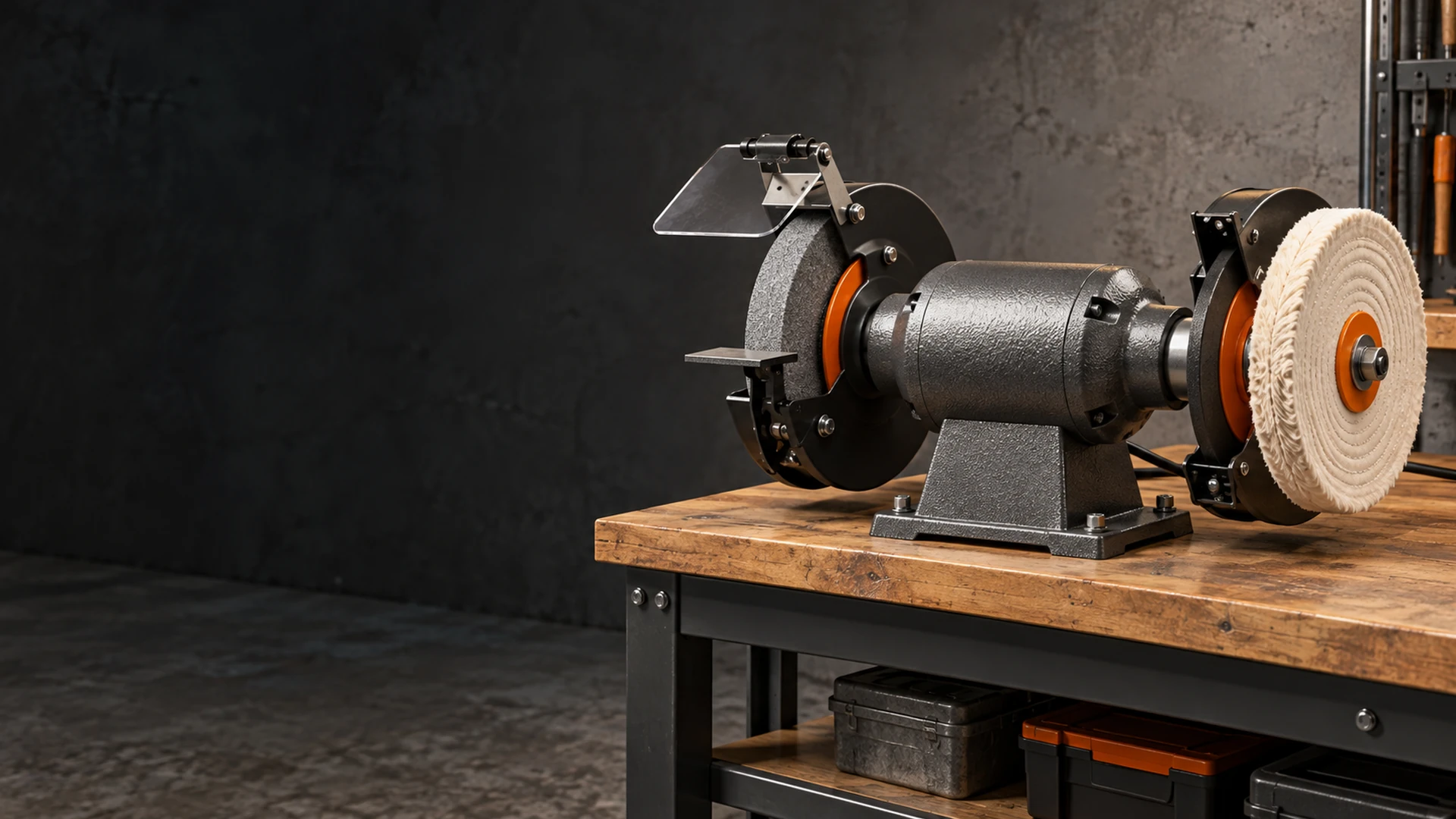
A bench buffer is built around polishing wheels and compounds. A grinder is configured for bonded abrasive wheels; do not assume accessories or safety requirements are interchangeable.
Compare current bench buffer options
Check the exact motor model, compatible wheel dimensions and supplied accessories before purchasing.
Check PricesCheck PricesHow we evaluated bench buffers
We compared documented shaft speed, motor rating, wheel capacity, arbor arrangement and workshop use cases. No hands-on testing is claimed.
What we checked, and what we did not
The selection weighs wheel compatibility, polishing speed, workpiece clearance, motor construction and safety requirements. Verify exact current manuals; advertised ratings are not independent test results.
The selection weighs wheel compatibility, polishing speed, workpiece clearance, motor construction and safety requirements. Verify exact current manuals; advertised ratings are not independent test results.
What matters most
- Check published specifications, wheel ratings, mounting, ventilation and safe workholding.
- Check published specifications, wheel ratings, mounting, ventilation and safe workholding.
- Check published specifications, wheel ratings, mounting, ventilation and safe workholding.
- Check published specifications, wheel ratings, mounting, ventilation and safe workholding.
- Check published specifications, wheel ratings, mounting, ventilation and safe workholding.
Three numbers that affect polishing
Wheel surface speed increases with both RPM and wheel diameter. These are illustrative calculations, not performance tests.
Surface speed estimates use pi x wheel diameter (inches) x RPM / 12. Actual wheel diameter, load and slip can change real operation. Never exceed wheel or machine ratings.
Which bench buffer suits your work?
Start with the material, finish and wheel requirements rather than buying by horsepower alone.
Choose high speed only when wheel and workpiece allow it.
Read Grizzly G1061 reviewA slower spindle can help manage heat on delicate finishes.
Read Grizzly G1061Z reviewTwo published speeds broaden the range of polishing tasks.
Read Eastwood Dual-Speed reviewCompact variable-speed polishing for smaller parts.
Read Grizzly T32004 reviewFive bench-buffer buying mistakes
Wheel speed ratings are safety limits, not suggestions.
Confirm thread direction, bore size and proper wheel flanges.
Workpieces can be caught and thrown; use approved holding methods.
Residue from coarse compound can scratch a fine finish.
Polishing debris and compounds require suitable ventilation and PPE.
Bench buffer FAQs
What is a bench buffer used for?
A bench buffer uses polishing wheels and compounds to refine metal and other approved surfaces. It is not a substitute for a grinding wheel.
How does buffer shaft speed affect polishing heat and control?
Lower RPM reduces rim speed for a given wheel diameter; higher RPM may polish faster but can raise heat and grab risk. Match speed to the workpiece and wheel rating.
When is a dedicated bench buffer preferable to a grinder conversion?
Not automatically. Confirm the grinder manufacturer permits the accessory and that arbor, flanges, wheel diameter and speed are compatible.
Do bench buffers include polishing wheels?
Not always. Some are motor-only units; verify what comes in the box before comparing prices.
How should I choose buffing compound for a dedicated bench buffer?
Choose a compound matched to the material and stage of polishing. Keep separate wheels for coarse and final finishing.
How do I secure a bench buffer?
Follow the mounting-hole layout in the machine manual and fasten it to a stable bench or approved stand.
What protective equipment is appropriate for bench buffing?
Use suitable eye and respiratory protection, control dust, secure hair and clothing, and follow the manual for holding workpieces safely.
Related workshop guides
Research notes & specification sources
Research approach: manufacturer-published model details were compared without physical testing. Verify current specifications, wheel ratings and manual instructions before use.