
Best Air Compressor Regulators
Compare workshop air regulators by port size, outlet setpoint, gauge design and flow capacity—not tank PSI alone.
Compare Air RegulatorsSee Regulator OptionsAffiliate disclosure: As an Amazon Associate, WorkshopGearGuide may earn from qualifying purchases made through qualifying links, at no additional cost to you. Retailer specification links below are provided for verification and are not represented as Amazon offers.
Air compressor regulators compared by pressure control and line size
These regulator families serve different pneumatic jobs. Compare downstream pressure control, gauge configuration, flow capacity and port compatibility; do not assume all four are interchangeable.
| Regulator / best use | Control design | Key specification | Main limitation | Shopping |
|---|---|---|---|---|
| SMC AR20-D / AR-D Series General workshop outlet regulation | General-purpose | Up to 125 PSI | Part numbers vary by port, gauge, relieving function and pressure range; choose the precise NPT configuration. | See Prices |
| SMC ARG20-B / ARG-B Series Read pressure without a projecting external gauge | Built-in gauge | Built-in | The older ARG range is being succeeded by ARG-B; confirm the current configured SKU and backflow option. | See Prices |
| SMC ARP20/30/40 Precision Series Fine adjustment for low-variation processes | Precision control | Within 0.2% F.S. | Unnecessary expense for many impact tools; precise pressure control cannot compensate for undersized compressor flow. | See Prices |
| Parker P3NRA96BNG Hi-Flow High-flow manifold or larger pneumatic lines | High-flow 3/4 in. | 250 PSIG | 3/4-inch ports and industrial-scale capacity are oversized for many home shops; flow is measured under specified test conditions. | See Prices |
A regulator lowers and stabilizes downstream pressure; it cannot supply more air than the compressor delivers. Match pressure and flow ratings to the actual tool and line.
Air pressure regulator reviews by workshop use
Four documented regulator families, from general-purpose outlet control to precision adjustment and industrial high flow.
SMC AR20-D / AR-D Series
Best for: General workshop outlet regulation
Best fit: General workshop outlet regulation.
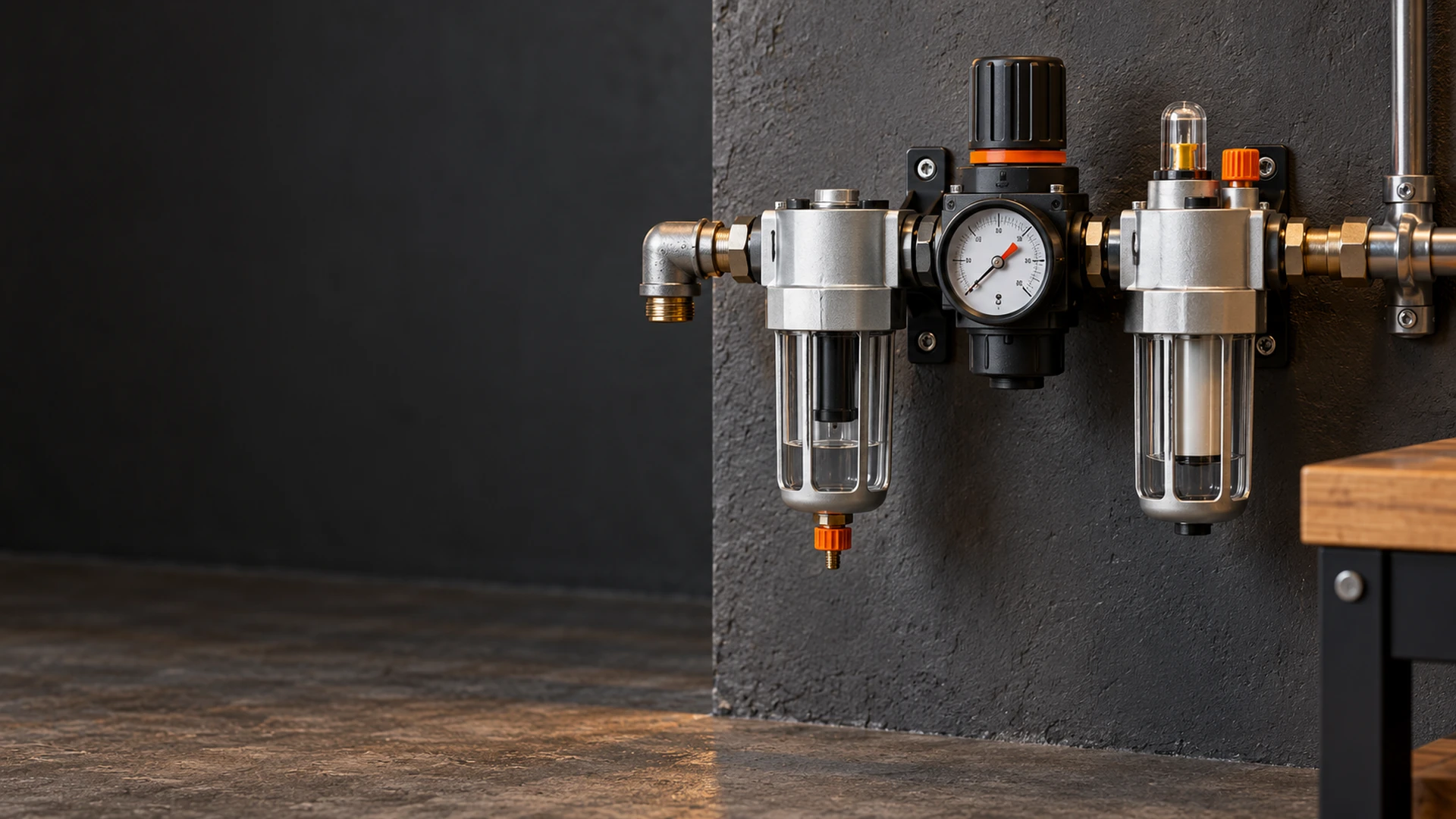
The SMC AR-D series is a practical general-purpose starting point for a workshop branch line. The AR20-D through AR60-D range includes NPT-thread configurations and gauge options, with a published maximum set pressure of 125 psi. It regulates downstream pressure but does not remove water or oil aerosols. Select the exact port size, mounting bracket and gauge option from the configuration sheet.
Strength: Modular construction, updated adjustment handle and integrated gauge options.
Trade-off: Part numbers vary by port, gauge, relieving function and pressure range; choose the precise NPT configuration.
Use case: General workshop outlet regulation
SMC ARG20-B / ARG-B Series
Best for: Read pressure without a projecting external gauge
Best fit: Read pressure without a projecting external gauge.
The SMC ARG-B family puts the pressure gauge within the regulator body. This is useful beside narrow benches or wall-mounted compressor plumbing where an exposed gauge could be bumped. SMC lists body sizes 20, 30 and 40, selectable gauge orientation and optional backflow functionality. Gauge integration does not guarantee a particular port thread or working range: order by exact part number.
Strength: Built-in pressure indication and selectable gauge orientation reduce external protrusions.
Trade-off: The older ARG range is being succeeded by ARG-B; confirm the current configured SKU and backflow option.
Use case: Read pressure without a projecting external gauge
SMC ARP20/30/40 Precision Series
Best for: Fine adjustment for low-variation processes
Best fit: Fine adjustment for low-variation processes.
SMC describes the ARP20/30/40 as a precision direct-operated regulator, with sensitivity within 0.2% of full scale and repeatability within ±1% of full scale. These are manufacturer ratings under specified conditions, not independent shop-test results. It is better suited to controlled pressure-fed work or test setups than ordinary tire inflation. Confirm the desired pressure range and gauge configuration.
Strength: Published fine sensitivity and repeatability with a lockable adjustment knob.
Trade-off: Unnecessary expense for many impact tools; precise pressure control cannot compensate for undersized compressor flow.
Use case: Fine adjustment for low-variation processes
Parker P3NRA96BNG Hi-Flow
Best for: High-flow manifold or larger pneumatic lines
Best fit: High-flow manifold or larger pneumatic lines.
Parker lists the P3NRA96BNG as a 3/4-inch NPT high-flow regulator with gauge, 250-psig maximum supply pressure and 200-SCFM flow capacity under a 100-psig inlet, 90-psig no-flow setting and 10-psig drop. This rating is not a promise of 200 CFM at every downstream pressure. Choose it for appropriately sized supply plumbing rather than as a default replacement for a 1/4-inch compressor outlet.
Strength: High-flow balanced-poppet design with self-relieving behavior and a supplied pressure gauge.
Trade-off: 3/4-inch ports and industrial-scale capacity are oversized for many home shops; flow is measured under specified test conditions.
Use case: High-flow manifold or larger pneumatic lines
Six regulator checks before buying
Choose an air pressure regulator in four steps
1. Determine tool operating PSI
Identify the pressure needed at the tool, not the compressor tank maximum.
2. Size the line and fittings
Match port thread and pipe diameter to the actual air-line installation.
3. Read the flow curve
Use manufacturer pressure-drop data at your required air consumption.
4. Choose gauge and relief behavior
Confirm whether the regulator relieves downstream pressure and whether a gauge or bracket is included.
Compare workshop pressure regulators
Shop by set pressure, port thread and delivered airflow—not gauge appearance alone.
Compare rolling cabinetsCompare drawer organizersHow workshop regulators were evaluated
We compared regulation ranges, flow curves, port sizes and relieving mechanisms from official manufacturer specifications and operating documents. This is a specification-based buyer guide, not a claim of hands-on testing.
Published pressure-control specifications
We reviewed manufacturer regulator families for setpoint limits, flow test conditions, gauge options, port sizes, relief and precision features. No bench testing or calibrated pressure measurements were performed.
Not hands-on tested: We did not independently verify regulation accuracy, pressure droop, gauge calibration, or long-term stability. Published manufacturer figures may use different test conditions and are not independent performance results.
Regulator comparison criteria
- Pressure adjustment range and maximum inlet pressure.
- Thread size, mounting and directional compatibility.
- Flow and pressure drop under documented test conditions.
- Relieving or backflow options and gauge availability.
- Precision control versus ordinary pneumatic-tool requirements.
Three pressure-regulator specifications to understand
Set pressure, flow and precision describe different properties. They should never be treated as interchangeable performance scores.
Manufacturer-published figures under different conditions. The 200-SCFM figure uses a 10-psi pressure-drop test; not a directly comparable home-compressor output.
Choose a regulator for the pneumatic job
Start with the line size and pressure behavior, then choose specialized features only when needed.
Modular regulator with up to 125-psi setpoint and configurable NPT ports.
See regulator detailsIntegrated pressure gauge for constrained mounting positions.
See regulator detailsPrecision adjustment with documented repeatability.
See regulator detailsLarge 3/4-inch ports and a published 200-SCFM flow test.
See regulator detailsFive mistakes when selecting air compressor regulators
The regulator controls outlet pressure; the compressor tank can operate at a different pressure.
Identical NPT ports do not guarantee equal SCFM at a given pressure drop.
Some regulator configurations omit the gauge or require an accessory.
A non-relieving regulator may leave downstream pressure trapped after turning down the knob.
Water removal requires a filter, separator or dryer chosen for the application.
Air compressor regulator FAQs
What does an air compressor regulator actually do?
It reduces and controls downstream pressure supplied to a tool or air line. It does not increase compressor flow capacity or remove moisture.
Should I regulate pressure at the compressor or at the tool?
For long lines or pressure-sensitive equipment, a point-of-use regulator near the tool can compensate for upstream losses more predictably. Follow the tool maker instructions.
Is a 1/4-inch regulator enough for an impact wrench?
Not necessarily. Check the tool air-consumption rating and the regulator flow curve at the expected pressure drop; a small port may restrict high-demand tools.
What is a relieving air regulator?
A relieving design can vent excess downstream pressure when the setpoint is lowered. A non-relieving design generally cannot exhaust trapped downstream air by itself.
Do I need a regulator with a pressure gauge?
A gauge helps verify the adjusted downstream pressure. Some regulator variants include one, while others require a separate gauge.
Can a pressure regulator replace a water separator?
No. A regulator controls pressure, while a filter or separator removes certain contaminants and liquid water. A dryer may be required for low-dew-point air.
How do I choose a replacement regulator for my compressor?
Confirm inlet pressure rating, downstream setpoint range, NPT thread size, flow at pressure drop, mounting direction and relieving behavior. Depressurize before installation.
Related workshop guides
Manufacturer regulator specifications and technical references
Research approach. Reviewed official SMC and Parker regulator specifications for this guide. No hands-on regulator testing is claimed.
Official pressure, flow and configuration documents:
- SMC AR20-D to AR60-D specifications
- SMC ARG-B built-in gauge regulator details
- SMC ARP precision regulator specifications
- Parker P3NR regulator official catalog
Confirm exact model variants, port threads, gauge options and flow charts before installation. Never exceed rated inlet pressure. Shopping links are searches.