
Best Air Compressor Filters and Dryers
Compare coalescing filters, point-of-use desiccant treatment and refrigerated dryers by what each removes, rated airflow and maintenance.
Compare Air TreatmentSee Dryer OptionsAffiliate disclosure: As an Amazon Associate, WorkshopGearGuide may earn from qualifying purchases made through qualifying links, at no additional cost to you. Retailer specification links below are provided for verification and are not represented as Amazon offers.
Compressed-air filters and dryers by treatment type
These four devices solve different problems. Choose a coalescing filter for aerosols, a desiccant stage for vapor at the point of use, or a refrigerated dryer for a powered shop air line.
| Product / best use | Treatment type | Published specification | Main limitation | Shopping |
|---|---|---|---|---|
| Campbell Hausfeld PA208503AV Air Cleaner/Dryer Point-of-use moisture control for intermittent garage tasks | Desiccant point-of-use | 3/8 in. | Desiccant has finite capacity and must be serviced; confirm actual required dryness and airflow. | See Prices |
| Parker P3YFA96DSAN Coalescing Filter Oil aerosol and fine-particle removal on larger air lines | Coalescing prefilter | 0.01 micron | Not a vapor dryer; industrial 3/4-inch connection is excessive for many small compressors. | See Prices |
| Ingersoll Rand DA25INA100 Refrigerated Air Dryer Fixed small-shop distribution needing controlled moisture | 15-CFM refrigerated | 115V single phase | Requires power, cooling clearance and condensate drainage; rated airflow must exceed actual compressor delivery. | See Prices |
| Ingersoll Rand DA42INA100 Refrigerated Air Dryer Higher-flow shop lines and continuous pneumatic equipment | 25-CFM refrigerated | 38°F rated | Cost, footprint, power and drainage make it disproportionate for occasional nail-gun use. | See Prices |
Filter efficiency, desiccant service life and pressure dew point are different measures. These are use-case options, not a single ranked performance test.
Air filter and dryer reviews by treatment need
Compare what each system actually removes before evaluating installation cost or airflow.
Campbell Hausfeld PA208503AV Air Cleaner/Dryer
Best for: Point-of-use moisture control for intermittent garage tasks
Best fit: Point-of-use moisture control for intermittent garage tasks.
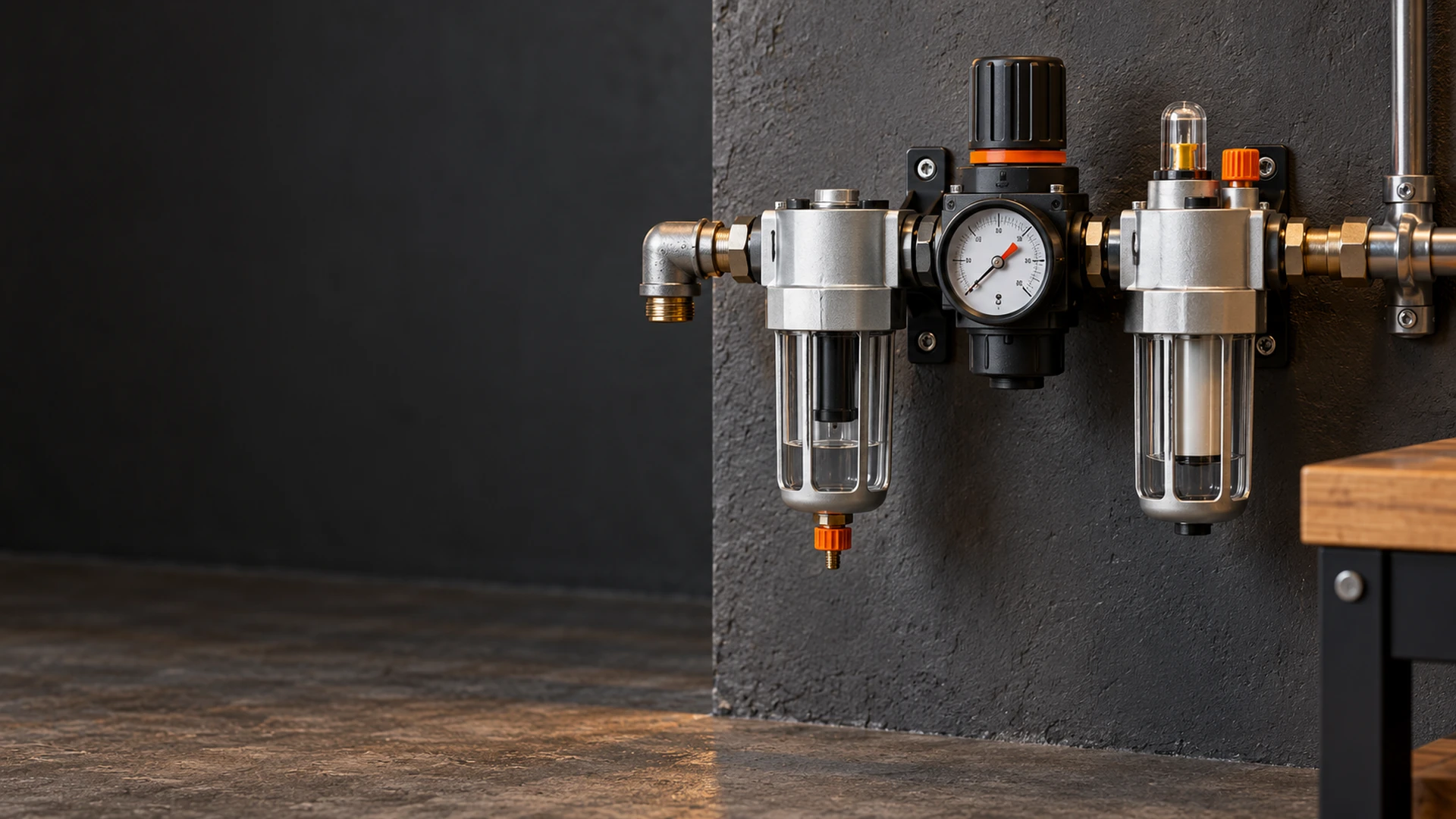
The manufacturer identifies a two-part system: a coalescing stage removes condensed water and contaminants, then desiccant reduces water vapor. The published 3/8-inch port and PA2086 replacement packs make this a point-of-use option, not a substitute for sizing a whole-shop dryer. Follow the manufacturer manual for orientation and replacement intervals.
Strength: Combines a coalescing stage with replaceable desiccant that adsorbs water vapor.
Trade-off: Desiccant has finite capacity and must be serviced; confirm actual required dryness and airflow.
Use case: Point-of-use moisture control for intermittent garage tasks
Parker P3YFA96DSAN Coalescing Filter
Best for: Oil aerosol and fine-particle removal on larger air lines
Best fit: Oil aerosol and fine-particle removal on larger air lines.
Parker lists the P3YFA96DSAN as a 3/4-inch coalescing filter with a 0.01-micron element and automatic drain. It targets aerosols and fine contamination; it does not establish a low pressure dew point. Check the full pressure-drop curve and element service requirements before adding it upstream of a dryer.
Strength: Documented fine coalescing media and automatic drainage for protecting downstream equipment.
Trade-off: Not a vapor dryer; industrial 3/4-inch connection is excessive for many small compressors.
Use case: Oil aerosol and fine-particle removal on larger air lines
Ingersoll Rand DA25INA100 Refrigerated Air Dryer
Best for: Fixed small-shop distribution needing controlled moisture
Best fit: Fixed small-shop distribution needing controlled moisture.
The US-market Ingersoll Rand DA25INA100 is listed at 15 CFM, 115V single phase and 3/8-inch MNPT connections. Unlike a simple trap, refrigeration cools compressed air to condense moisture and control its pressure dew point. The rated 15 CFM is a selection starting point; verify inlet-temperature and ambient derating before purchase.
Strength: Continuous powered drying for a small compressed-air distribution system.
Trade-off: Requires power, cooling clearance and condensate drainage; rated airflow must exceed actual compressor delivery.
Use case: Fixed small-shop distribution needing controlled moisture
Ingersoll Rand DA42INA100 Refrigerated Air Dryer
Best for: Higher-flow shop lines and continuous pneumatic equipment
Best fit: Higher-flow shop lines and continuous pneumatic equipment.
Ingersoll Rand lists the DA42INA100 at 25 CFM, a rated 38°F pressure dew point, 115V power and 1/2-inch FNPT connections. The published maximum inlet temperature is 120°F. This is a dedicated refrigerated dryer, not a filter element; select it using delivered CFM and ambient/inlet correction factors.
Strength: Documented 25-CFM capacity and 38°F pressure dew-point rating for a larger air-treatment system.
Trade-off: Cost, footprint, power and drainage make it disproportionate for occasional nail-gun use.
Use case: Higher-flow shop lines and continuous pneumatic equipment
Six checks before buying compressed-air treatment
Choose filters and dryers in four steps
1. Identify the air-quality requirement
Determine whether your process is harmed by dirt, oil aerosols, liquid water or water vapor.
2. Select the correct removal mechanism
Use filtration for particles and aerosols; choose desiccant or refrigerated drying when vapor control is required.
3. Size airflow and pressure loss
Match equipment rated CFM to compressor delivery and use correction factors for hot inlet air or warm rooms.
4. Budget for service and drainage
Leave room for element changes, desiccant replacement, drain routing and powered-dryer ventilation.
Compare compressed-air filtration and drying options
Start with the contaminant and required dew point, then compare capacity, maintenance and installation needs.
Compare rolling cabinetsCompare drawer organizersHow filters and dryers were evaluated
We compared filter grades, dryer capacity, pressure dew point and service requirements from official manufacturer specifications and operating documents. This is a specification-based buyer guide, not a claim of hands-on testing.
Manufacturer specifications, not laboratory tests
We checked Campbell Hausfeld, Parker and Ingersoll Rand documentation for treatment mechanisms, connection sizes, filter media, dryer CFM and dew-point claims. We did not independently measure moisture, aerosol carryover or airflow.
Not hands-on tested: We did not independently verify delivered dew point, actual contaminant capture, pressure drop, or filter service life. Published manufacturer figures may use different test conditions and are not independent performance results.
Comparison criteria
- Removal mechanism: coalescing, adsorption or refrigeration.
- Rated flow and pressure-dew-point specifications where available.
- Connection size and power requirements.
- Drainage, media replacement and maintenance burden.
- Use-case separation from simple liquid water traps.
Three specifications that matter for air quality
Micron size describes filtration, CFM describes throughput and pressure dew point describes dryness. Never treat these as equivalent.
Specifications are manufacturer-reported under stated conditions. Actual capacity varies with inlet temperature, pressure and ambient conditions.
Match the air treatment to the workshop task
Choose by the problem being solved rather than assuming the most expensive dryer is necessary.
Coalescing plus replaceable desiccant for a localized application.
See treatment detailsCoalescing filtration upstream of sensitive equipment; no vapor drying.
See treatment details15-CFM refrigerated drying when line capacity and ambient conditions match.
See treatment details25-CFM dryer with published 38°F rated pressure dew point.
See treatment detailsFive mistakes when specifying air filters and dryers
Removing aerosols and droplets does not establish a controlled pressure dew point.
A dryer must handle delivered compressor CFM at actual inlet and ambient conditions.
Oil and bulk water can shorten desiccant life or harm a dryer; follow the maker air-treatment sequence.
Automatic drains and dryer condensate need inspection and compliant collection.
Desiccant packs, coalescer elements, electricity and pressure drop affect ownership cost.
Air compressor filter and dryer FAQs
What is the difference between a compressor filter and a dryer?
A filter removes particles, oil aerosols or liquid droplets depending on its design. A dryer reduces water vapor to a specified pressure dew point.
Do I need a refrigerated air dryer in a home garage?
Not necessarily. Occasional inflation or nail-gun use may need only basic condensate control. Painting or moisture-sensitive continuous work can justify drying.
Can a coalescing filter remove water vapor?
No. Coalescing media collect aerosols and liquid droplets; water vapor requires a drying process.
How do I size a refrigerated air dryer?
Compare its rated CFM against compressor delivered CFM, then apply manufacturer corrections for inlet pressure, inlet temperature and ambient temperature.
Is a 0.01-micron filter better than a 38°F dew-point dryer?
Those numbers measure different things. The first is a filter grade; the second is a moisture-dryness rating. They may be used together.
Where should a desiccant dryer be installed?
Follow its manual. Point-of-use systems often sit downstream of bulk liquid removal and coalescing prefiltration to protect the desiccant.
What maintenance do air dryers and filters require?
Inspect condensate drains, replace coalescer elements and desiccant as specified, and maintain ventilation and electrical components on refrigerated units.
Related workshop guides
Official filter and dryer specifications
Research approach. Official manufacturer documentation for air treatment types, ratings and installation constraints. No independent performance testing claimed.
Official specification and installation references:
- Campbell Hausfeld cleaner/dryer product listing
- Parker P3Y coalescing filter catalog
- Ingersoll Rand DA-IN US dryer specification table
- Ingersoll Rand DA42INA100 official specifications
- Parker compressed-air filtration and dryer prefilter guidance
Confirm local model availability, airflow correction factors, electrical requirements and condensate handling. Shopping buttons lead to searches.