
Best Dust Collection Blast Gates for Woodworking Shops
Compare manual and automated blast gates for 4-inch collector ducting and smaller shop-vac branches. Choose by fitting compatibility, gate access and maintenance rather than nominal size alone.
Browse Blast GatesCompare OptionsAffiliate disclosure: As an Amazon Associate, WorkshopGearGuide may earn from qualifying purchases made through qualifying links, at no additional cost to you. Retailer specification links below are provided for verification and are not represented as Amazon offers.
Quick answer
Start with the duct you already own. A manual 4-inch gate suits most stationary collector branches; a smaller gate serves shop-vac lines; self-cleaning and motorized options make sense when debris buildup or frequent machine changes justify extra expense. Check actual fitting dimensions and compatibility before ordering.
Compare dust collection blast gates
These options serve different duct sizes and control methods. Nominal 4-inch and 2-1/2-inch labels do not guarantee identical outside diameters; verify whether your hose fits over or inside each port.
| Blast gate / best fit | Nominal connection | Control | Main consideration | Shop Options |
|---|---|---|---|---|
| POWERTEC 70108 4-Inch Blast Gate Budget manual gate | 4-inch nominal | Manual sliding | Low-cost branch shutoff | Check Prices |
| POWERTEC 70133 2-1/2-Inch Blast Gate Shop-vac branches | 2-1/2-inch nominal | Manual sliding | Smaller hose circuits | Check Prices |
| Rockler Dust Right 4-Inch Blast Gate Modular Dust Right | 4-inch nominal | Manual sliding | Rockler-oriented setups | Check Prices |
| Woodstock W1141 4-Inch Blast Gate Metal construction | 4-inch nominal | Manual sliding | Fixed duct branches | Check Prices |
| Oneida Air Systems 4-Inch Self-Cleaning Blast Gate Dust-prone systems | 4-inch nominal | Manual self-cleaning | Frequent gate operation | Check Prices |
| iVAC Pro 4-Inch Automated Blast Gate Automated collection | 4-inch nominal | Motorized control | Automatic machine switching | Check Prices |
Amazon links are product-category searches. Specific models sold by exclusive retailers may not be available on Amazon; verify model numbers before purchasing.
Detailed product evaluations
Six distinct options cover basic manual, smaller-diameter, self-cleaning and motorized branches. These are specification-led buying assessments, not hands-on leakage or airflow tests.
POWERTEC 70108 4-Inch Blast Gate
Configuration: 4-inch nominal; manual sliding
Published configuration: 4-inch nominal connection with manual sliding operation. Verify exact manufacturer model and port measurements.
Plastic construction keeps weight and price down, but inspect the slide for sawdust buildup and verify the fitting outside diameter before gluing or clamping.
Why consider it: Good for basic single-machine branches; simple hand operation.
Trade-off: Plastic edges and wear may limit long-term durability.
Best suited to: Starter 4-inch duct runs.
POWERTEC 70133 2-1/2-Inch Blast Gate
Configuration: 2-1/2-inch nominal; manual sliding
Published configuration: 2-1/2-inch nominal connection with manual sliding operation. Verify exact manufacturer model and port measurements.
A smaller nominal connection is useful for shop-vac-sized runs, but nominal sizing is not a guarantee of a tight fit to every vacuum hose or reducer.
Why consider it: Separates small-tool branches without requiring 4-inch main duct.
Trade-off: Smaller passage restricts large collector airflow.
Best suited to: Compact dust-extraction layouts.
Rockler Dust Right 4-Inch Blast Gate
Configuration: 4-inch nominal; manual sliding
Published configuration: 4-inch nominal connection with manual sliding operation. Verify exact manufacturer model and port measurements.
Consider this gate when the rest of your installation uses Dust Right ports. Check whether the chosen hose, coupler, and gate share the same mating geometry.
Why consider it: Useful integration with compatible Dust Right fittings.
Trade-off: Do not assume a universal fit across all 4-inch brands.
Best suited to: Dust Right hose networks.
Woodstock W1141 4-Inch Blast Gate
Configuration: 4-inch nominal; manual sliding
Published configuration: 4-inch nominal connection with manual sliding operation. Verify exact manufacturer model and port measurements.
A metal-bodied manual gate can be preferable in a fixed installation where the gate will be operated repeatedly. Keep the blade path accessible for cleaning.
Why consider it: Durable fixed-system alternative to basic plastic gates.
Trade-off: Confirm fit, mounting and slide maintenance requirements.
Best suited to: Stationary machine branches.
Oneida Air Systems 4-Inch Self-Cleaning Blast Gate
Configuration: 4-inch nominal; manual self-cleaning
Published configuration: 4-inch nominal connection with manual self-cleaning operation. Verify exact manufacturer model and port measurements.
A self-cleaning gate design aims to reduce packed chips around the sliding plate. Match the exact gate variant to the duct and do not assume it eliminates routine maintenance.
Why consider it: Designed to reduce debris accumulation at the gate.
Trade-off: Higher complexity and cost than a plain slide gate.
Best suited to: Busy woodworking shops.
iVAC Pro 4-Inch Automated Blast Gate
Configuration: 4-inch nominal; motorized control
Published configuration: 4-inch nominal connection with motorized control operation. Verify exact manufacturer model and port measurements.
Automated gates can coordinate branch opening with a compatible dust-collection control system. Verify controller, power, wiring and machine-sensor compatibility before buying.
Why consider it: Convenient for multi-machine automation.
Trade-off: Needs compatible controls and electrical planning.
Best suited to: Multi-machine automated systems.
Six buying checks before installing blast gates
Include caster swing, side handle, drawer extension and enough aisle clearance to stand in front of an open drawer.
Check the gate spigot outside diameter and whether your hose, pipe or coupling slides over or inside it.Count long breaker bars, sockets, organizers, cordless tools and cases. A high port size does not guarantee useful depth.
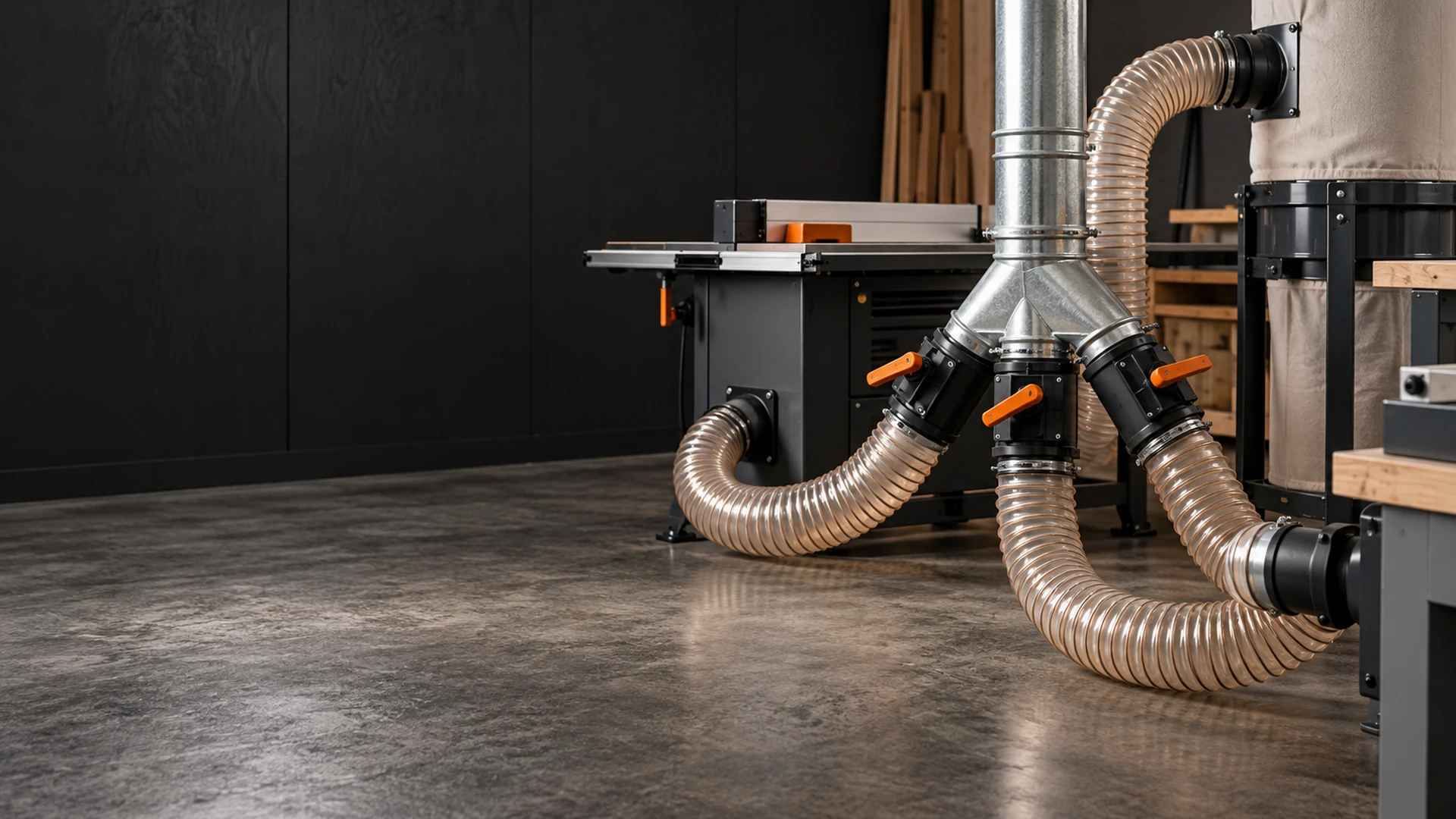
Place gates where you can reach them without climbing over machines or blocking workpieces.Cabinet working load, gate-slide capacity and storage volume are different. Confirm how each manufacturer defines them.
Fine dust and large shavings can lodge in sliding slots; keep the gate accessible for cleaning.A solid wood worktop supports light assembly; a blast gate may be better under a separate bench; a top chest adds height.
A 2-1/2-inch vacuum branch is not a substitute for a 4-inch collector main on a high-volume woodworking machine.Check shipping weight, ramps, doorways, floor level and caster locks. Heavy loaded cabinets are not meant to be casually pushed around.
Minimize unnecessary elbows, reducers and long flex runs, which increase resistance.Compare lock replacement, drawer slides, warranty, compatible top chests and local parts availability before committing.
Motorized gates need compatible controls, wiring and safe machine-start sequencing.How to choose the right blast gate
Manual versus automated
Manual slide gates are inexpensive and easy to diagnose. Automated systems can reduce missed branch closures but require compatible switches and controls.
4-inch versus 2-1/2-inch
Match the system type first: dust collectors commonly use larger ducting; portable vacuums often use smaller hose. Reducers do not create additional airflow.
Plastic versus metal
Plastic is light and economical. Metal can be attractive for permanent systems; either design can leak or jam if poorly fitted or packed with debris.
Gate position and maintenance
Install where the blade can fully travel, chips can be cleared, and the operator can see whether the branch is open.
Compare current dust collection gate options
Check exact port sizes and control-system compatibility before choosing a manual or automated branch shutoff.
Compare Blast GatesCompare Duct FittingsHow we compared dust collection blast gates
This is a published-specification comparison, not a controlled test of gate leakage, suction loss or long-term durability.
What we checked, and what we did not
We compared nominal connection size, manual or motorized operation, installation requirements, cleaning access, and suitability for collector or vacuum branch circuits.
Not hands-on tested: We did not measure leakage, pressure drop, motor response, slide wear or static discharge. Confirm all electrical and duct details from the exact model documentation.
What matters most
- Fit: verify the real outside and inside port dimensions.
- Airflow: keep duct size and collector requirements aligned.
- Operation: choose manual, self-cleaning or automated deliberately.
- Maintenance: allow access to the slide and chip trap.
- Controls: check automation and wiring compatibility.
Three measurements that matter for blast gates
Cross-sectional area alone does not predict flow. Duct length, bends, collector pressure, fittings and the gate blade all affect the operating result.
Cross-sectional area alone does not predict flow. Duct length, bends, collector pressure, fittings and the gate blade all affect the operating result.
Which blast gate fits your dust collection setup?
Choose based on existing duct size and whether you operate one or several machines.
Use an accessible manual 4-inch slide gate on a conventional stationary-machine branch.
Review this configurationUse a smaller-diameter gate only where it matches the actual vacuum hose and fittings.
Review this configurationA self-cleaning mechanism may reduce chip buildup but still needs periodic inspection.
Review this configurationMotorized gates suit coordinated systems when controller and wiring compatibility are established.
Review this configurationFive blast gate buying mistakes to avoid
Measure mating ports and check whether a fitting is intended for inside or outside hose connections.
A closed branch is only useful when the operator can reach the handle without interrupting work or creating hazards.
Sliding gates may jam when chips collect in the track. Inspect and clean them before forcing the blade.
A narrow reducer and hose can reduce useful airflow even when the collector motor is powerful.
Motorized gates require compatible controllers, power and machine-trigger logic; a gate alone is not a complete system.
Dust collection blast gate FAQs
What does a blast gate do in dust collection?
It opens or closes an individual duct branch so a collector can focus airflow on the machine currently in use.
Should a blast gate go near the machine or main trunk?
Either can work if the gate is accessible and the layout avoids unnecessary duct length. Plan around machine clearance and maintenance.
Will every 4-inch gate fit every 4-inch hose?
No. Nominal diameter does not guarantee matching outside diameters, wall thickness or coupling style. Measure both parts.
Do blast gates reduce suction?
Any fitting may add resistance, particularly if it has a narrow passage or poorly aligned blade. Actual loss depends on the system.
Are self-cleaning blast gates maintenance-free?
No. They can help clear the blade path, but still require inspection and cleaning when dust or chips accumulate.
Can an automated blast gate work without a controller?
Only if the exact model supports standalone operation. Many motorized gates require a compatible control and power arrangement.
Can I use blast gates with a shop vacuum?
Yes, when the fittings match the smaller hose and the vacuum is suitable for the tool and dust involved. Do not assume a large collector gate fits.
Related workshop guides
Research notes & specification sources
Research approach: This editorial comparison relies on product categories and published manufacturer information. Port measurements and exact model availability should be checked before ordering. No hands-on airflow testing was conducted.
Representative primary sources used for the comparisons and calculations:
- POWERTEC product catalog: manual blast gate models and connection sizes.
- Rockler Dust Right product catalog: modular dust collection fittings and blast gates.
- Oneida Air Systems and iVAC manufacturer catalogs: self-cleaning and automated gate options.
External source links are informational. Affiliate buttons on this page link to Amazon searches and may show alternative products rather than the exact retailer-exclusive model discussed.