
Best Track Saws for Home Workshops
Compare four corded plunge track saws for home workshops by cut depth, rail availability, speed control, dust extraction and package contents.
Compare Track SawsCompare Saw KitsAffiliate disclosure: As an Amazon Associate, WorkshopGearGuide may earn from qualifying purchases made through qualifying links, at no additional cost to you. Retailer specification links below are provided for verification and are not represented as Amazon offers.
Track saw comparison for home workshops
The key difference is the saw-and-rail system, not simply motor amperage. Published cutting depths and package contents are not standardized across makers.
| Track saw | Cutting depth | Motor / speed | Key buying caution | Shopping |
|---|---|---|---|---|
| Makita SP6000J Sheet-goods cutting with variable blade speed | 2-3/16 in at 90° | 12 A; 2,000–5,200 RPM | SP6000J saw package does not include a guide rail; the SP6000J1 bundle does. | See Prices |
| Festool TS 55 FEQ-F-Plus Frequent cabinet-panel and finish cuts | 2-1/8 in / 55 mm | 1,200 W; 2,000–5,800 RPM | Premium saw ecosystem; confirm the exact rail and accessories included with the selected package. | See Prices |
| DEWALT DWS520K Woodworkers wanting a riving knife and bidirectional rail system | 2-1/8 in on track | 12 A; 6-1/2 in blade | The DWS520K base kit listing differs from DWS520CK, which explicitly bundles 59- and 102-inch tracks. | See Prices |
| Bosch GKT13-225L Panel cutting with track-fit adjustment and dust extraction | 2-1/4 in max (manual) | 13 A; 3,600–6,250 RPM | Bosch FSN guide tracks are sold separately; check compatible FSN lengths and connectors. | See Prices |
Cutting depths are manufacturer-stated. Track thickness, blade choice and saw setup can affect actual capacity. Check the exact kit contents.
Which track saw suits your workshop?
Four manufacturer-documented corded saws illustrate different rail ecosystems, controls and cutting workflows.
Makita SP6000J
Best fit: Sheet-goods cutting with variable blade speed
Best for: Sheet-goods cutting with variable blade speed.
Makita publishes a 12-amp motor, 2-3/16-inch maximum cut at 90 degrees, 1-9/16-inch at 45 degrees and a 2,000–5,200 RPM speed range. The SP6000J1 is a separate kit including a 55-inch rail; confirm the listing before ordering.
Strength: Variable-speed control and 48-tooth blade support different sheet materials.
Tradeoff: SP6000J saw package does not include a guide rail; the SP6000J1 bundle does.
Check first: Confirm saw voltage, compatible rail, included accessories, blade arbor and dust-hose fit.
Festool TS 55 FEQ-F-Plus
Best fit: Frequent cabinet-panel and finish cuts
Best for: Frequent cabinet-panel and finish cuts.
Festool lists a 1,200-watt corded motor, 55-mm maximum cutting depth and 160-mm blade. The riving knife and dust extraction interface are system-specific strengths, but the package and rail contents must be checked separately.
Strength: Riving knife, splinterguard support and compatible extraction accessories form an integrated system.
Tradeoff: Premium saw ecosystem; confirm the exact rail and accessories included with the selected package.
Check first: Confirm saw voltage, compatible rail, included accessories, blade arbor and dust-hose fit.
DEWALT DWS520K
Best fit: Woodworkers wanting a riving knife and bidirectional rail system
Best for: Woodworkers wanting a riving knife and bidirectional rail system.
DEWALT documents 2-1/8-inch on-track cutting depth at 90 degrees and 1-5/8 inches at 45 degrees. The 12-amp saw has a riving knife and anti-kickback mechanism; compare DWS520K and DWS520CK package contents carefully.
Strength: Manufacturer specifies a dual-edged zero-clearance track system and continuous anti-kickback mechanism.
Tradeoff: The DWS520K base kit listing differs from DWS520CK, which explicitly bundles 59- and 102-inch tracks.
Check first: Confirm saw voltage, compatible rail, included accessories, blade arbor and dust-hose fit.
Bosch GKT13-225L
Best fit: Panel cutting with track-fit adjustment and dust extraction
Best for: Panel cutting with track-fit adjustment and dust extraction.
Bosch publishes a 13-amp motor, variable speed and a 6-1/2-inch blade. Its manual specifies up to 2-1/4 inches of cutting depth at 90 degrees; track setup and actual usable depth should be verified for the intended configuration.
Strength: Front and rear tracking adjustments and a swiveling extraction port support precise setup.
Tradeoff: Bosch FSN guide tracks are sold separately; check compatible FSN lengths and connectors.
Check first: Confirm saw voltage, compatible rail, included accessories, blade arbor and dust-hose fit.
Six track saw checks before you buy
Choose a track saw in four steps
1. Define your panel and material
Identify whether you cut plywood, MDF, doors or thicker solid lumber.
2. Verify on-track cutting depth
Check manufacturer depth at 90 and 45 degrees with the intended track.
3. Choose the rail ecosystem
Compare available rail lengths, connectors, clamps and package contents.
4. Plan dust extraction and support
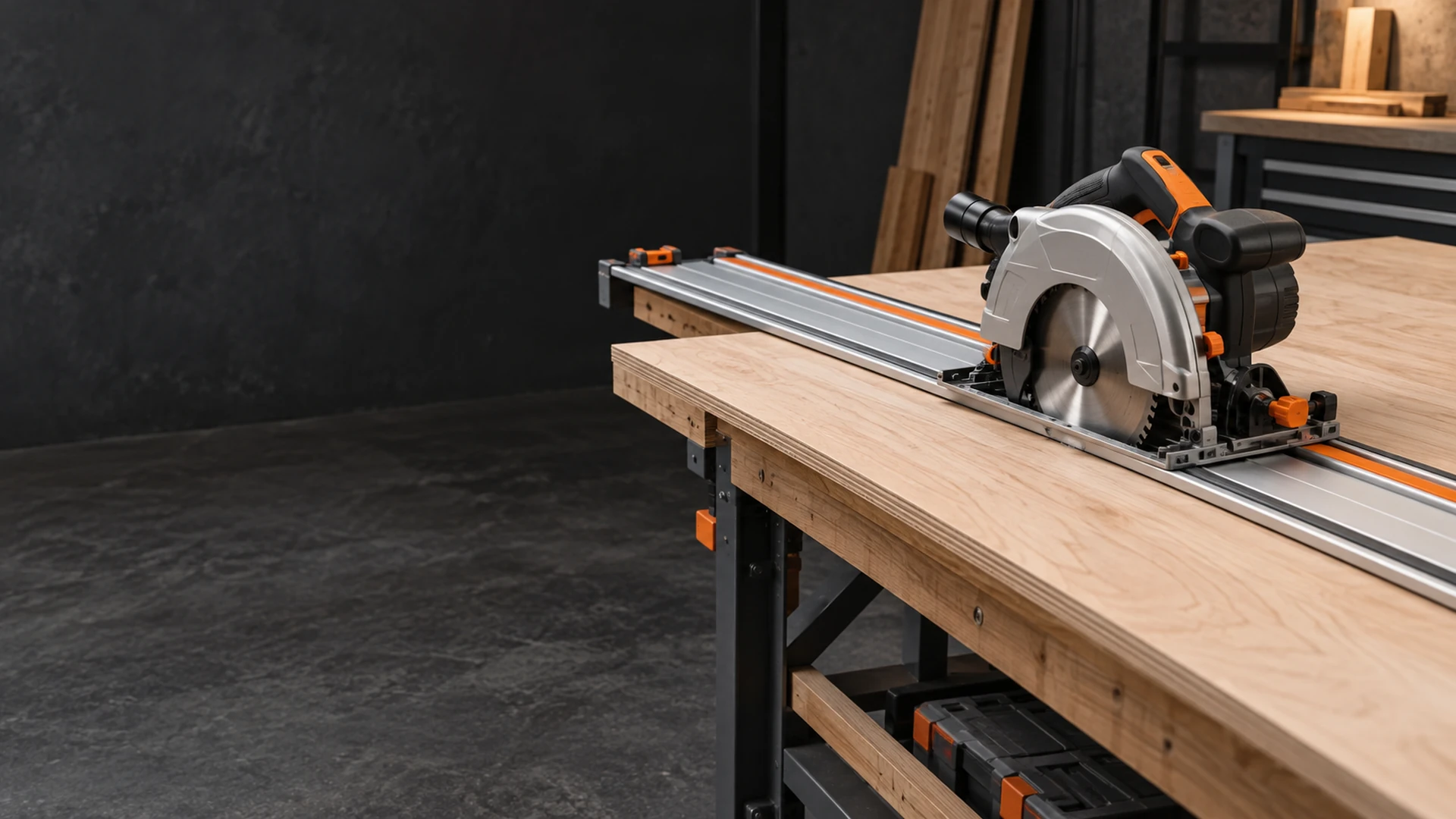
Support full sheets on a sacrificial surface and fit a compatible extraction hose.
Compare track saw systems and kit contents
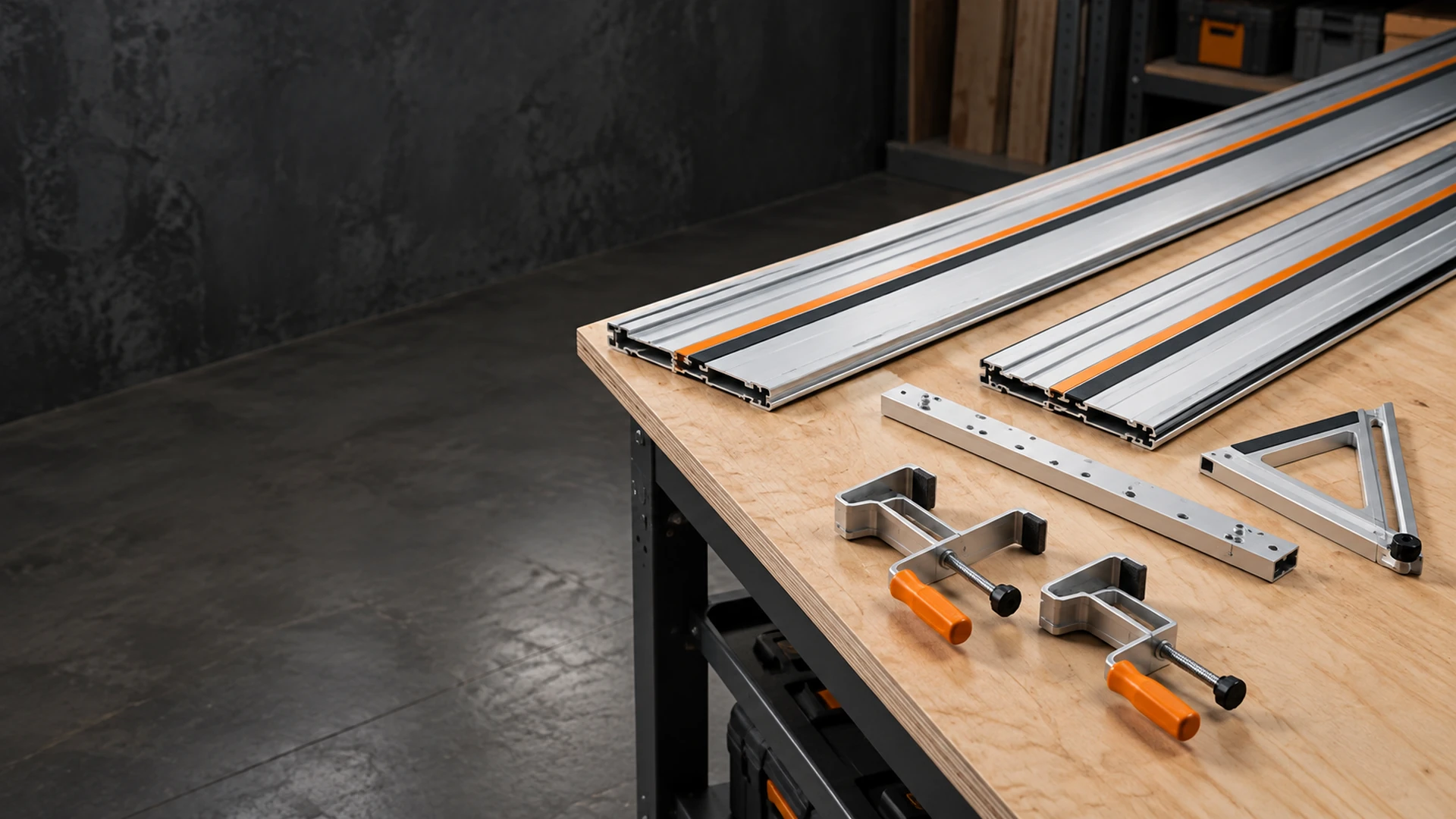
Choose the saw and compatible guide track together; do not assume the lowest-priced kit includes the rail.
Compare rolling cabinetsCompare drawer organizersHow these track saw specifications were researched
A manufacturer-specification comparison, not a hands-on performance ranking.
Official saw and guide-system documentation
We reviewed Makita, Festool, DEWALT and Bosch documentation for motor rating, cutting depth, blade size, speed control, guide-track compatibility and stated kit contents. No saw was operated or physically tested for accuracy, dust capture or tear-out.
Not independently tested: We did not measure actual cut straightness, blade deflection, vibration, dust capture or noise. Motor amperage alone cannot establish cutting performance across these saws.
Comparison criteria
- Published on-track or maximum cutting depth.
- Rail availability and saw-to-track compatibility.
- Blade size, motor rating and speed control.
- Dust extraction port and available adapters.
- Riving knife, anti-kickback and plunge features.
Three track saw specifications worth comparing
Manufacturer-published figures; compare like-for-like conditions.
These numbers do not represent head-to-head cutting tests. Compare blade condition, material, rail setup and depth conventions.
Match a track saw to your main cutting job
Consider the rail platform, saw controls and package contents together.
12-amp saw with variable speed; verify whether the chosen kit includes a rail.
See saw detailsRiving knife and manufacturer-matched accessories for repeat panel work.
See saw detailsZero-clearance dual-edged track system and documented anti-kickback features.
See saw detailsFront and rear tracking adjustments; FSN rail sold separately.
See saw detailsFive track saw buying mistakes to avoid
Many saw-only kits require buying the rail separately; check the manufacturer package list.
Some figures specify on-track depth, while others state maximum depth without the rail.
A dust port may require a particular hose size or adapter.
Similar rail extrusions are not proof of approved cross-brand compatibility.
Choose a compatible arbor, tooth count and blade specification for the panel being cut.
Track saw FAQs for home workshops
Is a track saw a replacement for a table saw?
For breaking down sheet goods and making long straight cuts, it can replace some table-saw tasks. It is less convenient for repeated narrow rip cuts and some joinery setups.
Do track saw kits always include a guide rail?
No. Makita sells SP6000J and a separate SP6000J1 rail bundle; Bosch lists FSN tracks separately. Check the exact model and contents.
What matters more: amps or cutting depth?
Start with adequate on-track cutting depth and blade compatibility. Amps alone do not predict real cutting speed or finish quality.
Can I use a track saw without dust extraction?
Follow the saw manual. A compatible extractor helps manage fine airborne dust; track saws are not dust-free even with extraction.
Which track saw is best for plywood?
All four are designed for wood sheet goods. Prioritize a suitable blade, enough rail reach, stable sheet support and accurate setup.
Do I need a riving knife on a plunge saw?
A riving knife can help reduce binding in supported cuts; follow the manufacturer’s operating instructions and do not treat it as a substitute for safe workpiece support.
Can one brand of guide rail work with another saw?
Sometimes adapters or manufacturer-approved combinations exist, but never assume compatibility from appearance alone. Verify the exact model and rail.
Related workshop guides
Official track saw specifications and kit sources
Research approach. Manufacturer specifications and kit listings were reviewed for each saw. This is not a hands-on cutting test.
Primary manufacturer documentation:
- Makita SP6000J specifications
- Festool TS 55 FEQ-F-Plus specifications
- DEWALT DWS520K specifications
- Bosch GKT13-225L specifications
Check current model availability, included rail, voltage and manual before purchasing.